
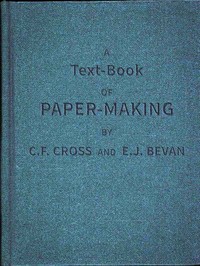
A Text-book of Paper-making by C. F. Cross and E. J. Bevan
Let's be clear: you won't find any fictional characters or a dramatic plot here. Instead, the 'story' is the incredible, real-world process of making paper. Authors Cross and Bevan act as expert guides, walking you through the entire journey from raw material to finished product. They start with the basics—what fibers can even be used (spoiler: a lot more than just wood!). Then, they meticulously explain the old-school methods, like manually preparing 'stuff' from rags, and the newer, late-19th century chemical and mechanical processes that were revolutionizing the industry.
The Story
The narrative is the science and craft itself. It's about taking something like discarded linen or esparto grass, cooking it, bleaching it, beating it into pulp, and then forming it into sheets. The book details the machinery of the era—the engines, the vats, the presses, and the drying lofts. It’s a systematic, chapter-by-chapter unveiling of a technology that was, at the time, the backbone of communication and record-keeping. There's a tangible sense of discovery on every page, as the authors connect simple actions to complex industrial outcomes.
Why You Should Read It
I picked this up out of sheer curiosity and was utterly absorbed. In our digital age, paper feels almost quaint, but this book restores its sense of wonder. It’s a masterclass in seeing the extraordinary in the ordinary. The writing, while technical, is driven by a clear passion for the subject. You get a real sense of the problem-solving and innovation of the time. It’s not just a 'how-to'; it's a 'why-it-matters.' Reading it changed my daily perspective. Now, when I feel the texture of a page or hear it rustle, I think about the intricate chain of events and human ingenuity that made it possible.
Final Verdict
This isn't for everyone. If you're looking for a beach read, look elsewhere. But if you have a curious mind and love 'how things work' deep dives, this is a hidden gem. It's perfect for makers, historians of technology, bibliophiles who want to understand the very substance of books, or anyone who enjoys the quiet satisfaction of learning a lost art. It’s a fascinating, grounding look at the physical foundation of our written world.
This historical work is free of copyright protections. You are welcome to share this with anyone.
Charles Walker
7 months agoMy professor recommended this, and I see why.
Kimberly Ramirez
1 year agoHonestly, it provides a comprehensive overview perfect for everyone. I will read more from this author.


John Harris
1 year agoThought-provoking and well-organized content.