
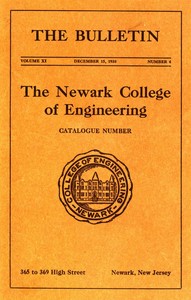
Newark College of Engineering Bulletin, v. 11, No. 4, December 15, 1938
Let's be clear: this isn't a book with a plot in the traditional sense. The Newark College of Engineering Bulletin from December 1938 is a document, a catalog, a piece of institutional paperwork. It lists courses for the coming semester, introduces faculty, outlines degree requirements, and details campus facilities. There are no characters, no rising action, no climax. The 'story' is the college itself, pushing forward with its mission of technical education during a profoundly uncertain time.
The Story
The 'plot' is the college's planned curriculum for 1939. It walks you through the paths a student could take: Civil, Electrical, Mechanical, or Chemical Engineering. You see the math they'd learn, the labs they'd work in, the textbooks they'd buy. There are notes on tuition ($200 per semester for day students), descriptions of the library's holdings, and even the rules for the student lounge. It's a blueprint for building engineers. The drama isn't written on the page; it's in the context. This document was published as the world was literally gearing up for war. The technologies these students were learning would soon be applied in unimaginable ways.
Why You Should Read It
I found this fascinating because it's so human. Stripped of narrative, you have to supply the emotion. You see a course in 'Radio Engineering' and think about the radar technology just around the corner. You read about the 'Materials Testing Laboratory' and wonder what those machines would soon be asked to analyze. It’s a lesson in quiet perseverance. While history remembers the big speeches and battles, this bulletin shows the mundane, essential work of preparing minds. It’s a reminder that the future is always being built by people doing their homework, literally and figuratively.
Final Verdict
This is not for everyone. If you need a fast-paced narrative, look elsewhere. But if you're a history nerd, especially interested in the pre-WWII American mindset, technology, or education, this is a rare peek behind the curtain. It's perfect for local historians from New Jersey, for alumni of NJIT (which this college became), or for anyone who loves primary sources that make you think. It's less a book to read and more an artifact to contemplate. You won't get a story, but you might just feel the weight of a moment in time.
You are viewing a work that belongs to the global public domain. You are welcome to share this with anyone.
Paul Thomas
8 months agoMy first impression was quite positive because the structural organization allows for quick referencing of key points. Top-tier content that deserves more recognition.
Patricia Martinez
5 months agoTo be perfectly clear, the author's voice is distinct and makes complex topics easy to digest. Thanks for sharing this review.
Christopher Johnson
4 months agoA must-have for anyone studying this subject.
Betty Nguyen
1 year agoVery helpful, thanks.




Patricia Moore
4 months agoIf you're tired of surface-level information, the case studies and practical examples provided add immense value. I'll be citing this in my upcoming project.