
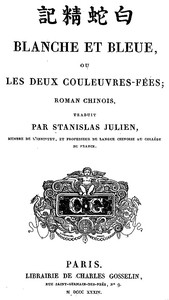
Blanche et Bleue ou les deux couleuvres-fées, roman chinois by Stanislas Julien
Let's get the confusing title out of the way first. Blanche et Bleue ou les deux couleuvres-fées, roman chinois translates to 'White and Blue or The Two Snake-Fairies, a Chinese Novel.' It's a mouthful! Published in 1834, this book is actually a French translation by a scholar named Stanislas Julien. The original Chinese story and author are lost to time, which adds this layer of mystery to the whole experience. You're reading a European interpretation of a classic Chinese tale, which is fascinating in itself.
The Story
The plot centers on two magical snake spirits, Blanche (White) and Bleue (Blue). These aren't your typical scary serpents; they're powerful, intelligent fairies who can take human form. Their peaceful existence in the spirit realm gets disrupted when they become involved with the human world. The story follows their adventures and misadventures as they navigate human emotions, societal rules, and the strict laws that govern spirits. There's love, there's trickery, and there are definitely consequences for crossing the boundaries between worlds. It's a classic fable structure—be careful what you wish for, and don't mess with forces you don't understand—but filled with the specific imagery and philosophy of Chinese folklore.
Why You Should Read It
I loved this book because it's a direct window into how stories traveled and transformed in the 1800s. You're not just reading a fantasy tale; you're seeing how a Western scholar chose to present Eastern mythology to a French audience. The characters of Blanche and Bleue are compelling. They're powerful yet vulnerable, wise yet prone to very human mistakes. Their dual nature—as both majestic spirits and beings capable of deep feeling—drives the whole narrative. The themes of forbidden love, the price of power, and the clash between natural and human law feel timeless.
Final Verdict
This book is a niche pick, but a rewarding one. It's perfect for readers who love myth and folklore, especially from non-Western traditions. It's also great for anyone interested in the history of translation and how cultures share stories. If you enjoy classics like Journey to the West or are curious about the roots of modern fantasy, you'll find a lot to appreciate here. Just go in knowing it's a product of its time—a beautiful, slightly strange, and utterly unique bridge between two literary worlds.
This text is dedicated to the public domain. Distribute this work to help spread literacy.
Sarah Jones
1 year agoAs someone who reads a lot, it provides a comprehensive overview perfect for everyone. Definitely a 5-star read.
Amanda Jackson
1 year agoI didn't expect much, but it manages to explain difficult concepts in plain English. A true masterpiece.







Barbara Harris
1 year agoMy professor recommended this, and I see why.