
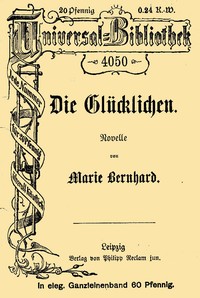
Die Glücklichen by Marie Bernhard
Let's talk about a book that's over a century old but feels like it could be written about a modern family struggling with expectations. Marie Bernhard's Die Glücklichen pulls back the curtain on the aristocratic von Brenken family.
The Story
The novel follows the von Brenkens, who are the envy of their social circle. They live on a grand estate, attend lavish parties, and uphold a flawless reputation. But Bernhard doesn't stay in the ballroom. She takes us into the private rooms and private thoughts. We meet the patriarch clinging to tradition, the mother smoothing over every conflict, and their adult children—each wrestling with their own quiet rebellion. One might yearn for a different career, another for a love that breaks the rules. The plot moves through their daily interactions, where a single glance or a carefully chosen word can carry the weight of a shouted argument. The real tension comes from watching this beautiful facade develop cracks, wondering who will be the first to stop pretending and what the cost will be.
Why You Should Read It
What struck me most was how familiar these characters felt. Even though their world of horse-drawn carriages and strict social codes is gone, their problems aren't. The pressure to meet your family's hopes, the gap between your public image and private self, the search for meaning—these are timeless. Bernhard writes with a keen, compassionate eye. She doesn't judge her characters as villains; she shows us how they're trapped by their own circumstances and the rules of their world. You won't find huge, dramatic twists here. Instead, the power is in the accumulation of small moments that make you think, 'I know that feeling.' It’s a slow, character-driven burn that rewards your attention.
Final Verdict
This book is perfect for readers who love historical fiction that focuses on psychology and relationships over sword fights or political intrigue. If you enjoy authors like Edith Wharton or Jane Austen for their social commentary, you’ll appreciate Bernhard's similar, sharp perspective from German society. It's also a great pick for anyone interested in rediscovering talented women writers from history whose work has been overlooked. Fair warning: it’s a contemplative read, not a fast-paced one. But if you're in the mood for a smart, nuanced story about family, freedom, and the price of happiness, Die Glücklichen is a hidden gem waiting to be found.
No rights are reserved for this publication. Thank you for supporting open literature.
Margaret Perez
6 months agoHelped me clear up some confusion on the topic.
Carol Torres
1 year agoGreat read!
Dorothy Martinez
1 year agoThanks for the recommendation.
Anthony Lopez
1 year agoThe index links actually work, which is rare!


Nancy Thompson
3 months agoI came across this while browsing and the emotional weight of the story is balanced perfectly. Exceeded all my expectations.