About 283 minutes
Maid Marian, and Other Stories — Edition Insights
Historical Psychological Social Fiction
64,906 recorded words. 31 minutes difference from this book's estimate.
View Gutenberg source #61194
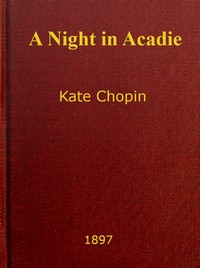
For A Night in Acadie — Context and Discussion, the stored edition analysis reports 72,101 words, 5 hr 14 min estimated reading time, and 24 detected text sections.
The text analysis averages about 17.7 words per sentence, while the detected sections provide another way to judge how the source is divided.
Project Gutenberg metadata also associates the work with “Short stories, American,” connecting these edition facts with the source record’s subject description.
Explore this collection
These alternatives are selected using recorded categories and estimated reading time.
About 283 minutes
Historical Psychological Social Fiction
64,906 recorded words. 31 minutes difference from this book's estimate.
View Gutenberg source #61194About 357 minutes
Historical Psychological Social Fiction
82,034 recorded words. 43 minutes difference from this book's estimate.
View Gutenberg source #56878About 262 minutes
Historical Psychological Social Fiction
60,166 recorded words. 52 minutes difference from this book's estimate.
View Gutenberg source #55024Search stored excerpts and compare books → Choose by your preferences →
Choices use stored catalog measurements. Estimates vary with reading speed. A shared category is a catalog label, not a claim that two books have the same argument or literary quality.
Search reads excerpt text stored with this catalog and links to its associated Gutenberg record. The connection is stored in the site database; this tool does not recheck that every excerpt is word-for-word identical to that external record. Excerpt search does not cover every chapter and does not verify historical publication dates.
Catalog snapshot checked: 2026-09-25. Coverage: 93 public books, 93 available source excerpts.
Calculated from edition completeness, EPUB availability, text structure and catalogue metadata. Not a user rating.
Total of 100 points, scaled to a 2.5-5.0 range. Editions with an empty description or a missing EPUB file are not scored.
Public-domain source text
The source text is kept in the dedicated reader, separate from this catalogue record and its commentary.
The opening story, 'A Night in Acadie,' introduces Telèsphore, a young farmer who leaves his plantation with 'a few dollars in his pocket' to spend Sunday near Marksville, hoping to escape the 'harassment' of choosing a wife. Chopin immediately establishes a pattern of restless movement and internal conflict: Telèsphore's home is 'like an empty temple,' and he has nearly proposed to a dozen women, each judged for flaws—Elvina's 'swarthy' skin, Amaranthe's excessive slenderness. The narrative voice shifts between ironic detachment and sympathy, a technique that recurs throughout the collection.
Several protagonists in A Night in Acadie are caught in cycles of hesitation or flight. Telèsphore's inability to settle on a wife mirrors the broader restlessness of characters like Athénaïse, who leaves her husband, or Ozème, who takes a holiday from his routine. Chopin often frames these escapes as temporary respites rather than solutions. The physical movement—from plantation to town, from home to bayou—parallels emotional vacillation. In 'Nég Créol,' Chicot's devotion to Mamzelle Aglaé is absolute, yet he cannot articulate his own motives; his actions are driven by a 'distorted' understanding of duty. The stories rarely resolve these tensions neatly, leaving characters suspended between desire and obligation.
Homes in these stories are rarely havens. Telèsphore's empty house is a 'temple' without an altar; Mamzelle Aglaé's 'upper room' in la maison grise becomes a prison of poverty and complaint. Chopin fills these interiors with sensory detail: the 'bucket of dirty water' on the landing, the 'café au lait' Chicot saves for his charge, the 'orange and a lump of ice' he gathers. Domestic labor is constant but often futile—the Irishwoman Brigitte scrubs and tends, yet Mamzelle Aglaé dies alone. The stories contrast the claustrophobia of these spaces with the open Louisiana landscape, where characters briefly find relief, as when Chicot hears the woman's wail 'mingled now with the croaking of the frogs' along the bayou.
Chopin renders speech in French-inflected English and Creole, marking class and ethnicity. Telèsphore's internal monologue is standard English, but characters like Chicot speak in dialect: 'Vous pas bézouin tisane, Mamzelle Aglaé?' The Irishwoman Brigitte's brogue ('a shtout shtick') adds another layer. These voices are not merely decorative; they signal social positions. Chicot, a Black man, serves the white, impoverished Mamzelle Aglaé with a devotion that borders on self-erasure. The stories quietly observe these hierarchies without overt commentary. In 'A Dresden Lady in Dixie,' a porcelain figurine becomes a symbol of misplaced value, while in 'Nég Créol,' Chicot's purchase of a grigri from 'Mimotte the Voudou' for fifteen cents reveals a syncretic spiritual world beneath the Catholic surface.
Chopin often shifts scenes abruptly, following a character from a domestic interior to a public street or natural setting. In 'A Night in Acadie,' Telèsphore's journey is traced in short, episodic paragraphs; in 'Nég Créol,' Chicot's errands take him from market to shanty to the upper room. These movements create a rhythm of anticipation and disappointment. Many stories end without closure: Telèsphore's fate is left open, Mamzelle Aglaé dies while Chicot is away, and the reader is left with his 'whine' of grief. Chopin resists moralizing or summarizing, instead letting the final image—Chicot standing 'shaking' with his bag on the floor—carry the emotional weight. This technique invites readers to sit with ambiguity rather than resolution.
Readers approaching A Night in Acadie should attend to the spaces between events—the pauses, the unspoken thoughts, the moments when characters simply observe. Chopin's prose rewards attention to small gestures: a dropped bag, a saved cup of coffee, a grigri hidden near an altar. The collection does not build toward a grand statement but accumulates meaning through repetition and variation. Treat each story as a discrete experiment in voice and structure, and notice how the same themes—longing, duty, escape—echo across different lives and landscapes.
A little like Chopin’s quiet indecisions, where a life’s direction waits in the twilight—that same patient ache seems to live under the long-simmering hopes of "Martin of Nitendi"; and The River of Dreams 1901 — Context and Discussion. I recall finishing both with a strange gentleness, a half-smile at choices left suspended.
Save your reaction, strongest insight, and memorable passage.