About 283 minutes
Maid Marian, and Other Stories — Edition Insights
Historical Psychological Social Fiction
64,906 recorded words. 21 minutes difference from this book's estimate.
View Gutenberg source #61194
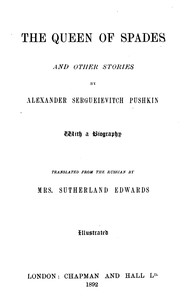
The Queen of Spades, and other stories — Key Ideas to Explore can be approached with a clearer sense of reading commitment from its source measurements: 60,166 words, 4 hr 22 min estimated reading time, and 7 detected text sections.
The text analysis averages about 14.7 words per sentence, while the detected sections provide another way to judge how the source is divided.
Project Gutenberg metadata also associates the work with “Russia -- Social life and customs -- Fiction,” connecting these edition facts with the source record’s subject description.
Explore this collection
These alternatives are selected using recorded categories and estimated reading time.
About 283 minutes
Historical Psychological Social Fiction
64,906 recorded words. 21 minutes difference from this book's estimate.
View Gutenberg source #61194About 229 minutes
Historical Psychological Social Fiction
52,562 recorded words. 33 minutes difference from this book's estimate.
View Gutenberg source #62030About 225 minutes
Historical Psychological Social Fiction
51,570 recorded words. 37 minutes difference from this book's estimate.
View Gutenberg source #24822Search stored excerpts and compare books → Choose by your preferences →
Choices use stored catalog measurements. Estimates vary with reading speed. A shared category is a catalog label, not a claim that two books have the same argument or literary quality.
Search reads excerpt text stored with this catalog and links to its associated Gutenberg record. The connection is stored in the site database; this tool does not recheck that every excerpt is word-for-word identical to that external record. Excerpt search does not cover every chapter and does not verify historical publication dates.
Catalog snapshot checked: 2026-09-25. Coverage: 93 public books, 93 available source excerpts.
Calculated from edition completeness, EPUB availability, text structure and catalogue metadata. Not a user rating.
Total of 100 points, scaled to a 2.5-5.0 range. Editions with an empty description or a missing EPUB file are not scored.
Public-domain source text
The source text is kept in the dedicated reader, separate from this catalogue record and its commentary.
The opening biography presents Pushkin as a poet shaped by French literature and a noble lineage traced to Alexander Nevsky, yet the stories that follow often undercut aristocratic pretension. In 'The Lady Rustic,' the narrator describes provincial girls whose 'only knowledge of the world is drawn from books,' a detail that echoes the translator's own framing of Pushkin's education. The catalog subjects list 'Russia -- Social life and customs' and 'Short stories, Russian -- Translations into English,' but the excerpts reveal a narrower focus: the manners of the gentry, not the peasantry, and a tone that wavers between romanticism and satire.
Mrs. H. Sutherland Edwards's 1892 translation, as seen in the excerpts, frequently adds explanatory or moralizing phrases absent from Pushkin's original. For instance, the narrator in 'The Lady Rustic' interrupts a description of provincial girls to assert that 'superficial sneers cannot impair their real merits,' a defensive tone that may reflect Victorian sensibilities rather than Pushkin's more detached irony. The biography, likely by Edwards, emphasizes Pushkin's French education and his mother's descent from 'Peter the Great's famous negro,' framing the author as an exotic figure for English readers. This editorial lens shapes how the stories present Russian society: as a curious, slightly barbaric world that needs translation both linguistically and culturally.
In 'The Lady Rustic,' the hero Alexis wears 'a black ring with a death's head on it,' a Gothic accessory that signals his Byronic pose. This object recurs in the story's social comedy: the provincial young ladies are captivated by his 'gloomy and disenchanted' persona. The ring is a concrete detail that ties the story to the catalog subject of 'Russia -- Social life and customs' by showing how European romantic fashions were adopted and parodied in the Russian countryside. The excerpts also mention a 'brass candlestick' in 'The Pistol Shot' and a 'greasy dressing gown' in another story, suggesting that Pushkin uses material objects to anchor his narratives in a specific, often unglamorous, reality.
The excerpts reveal a narrator who frequently addresses the reader directly. In 'The Lady Rustic,' the narrator says 'Those readers who have not seen our country life can hardly realize the charm of these provincial girls,' then immediately adds 'Let not this be regarded as condemnation.' This self-conscious commentary creates a conversational tone but also distances the reader from the story's events. The catalog subject 'Short stories, Russian -- Translations into English' does not capture this metafictional quality. The biography, too, interrupts the narrative flow with a long list of illustrations, reminding the reader that this is a mediated text. The structure thus reflects the tension between Pushkin's original storytelling and the translator's desire to guide interpretation.
Readers should approach this collection as a layered artifact: Pushkin's early 19th-century tales filtered through a late Victorian translator's sensibility. The catalog subjects promise a window into Russian social life, but the excerpts show that window framed by editorial commentary and period-specific language. Pay attention to the footnotes, the biography, and the illustrations listed in the contents—they are part of the reading experience. The stories reward attention to small, telling details like the black ring or the greasy dressing gown, which often carry more weight than the narrator's moral asides.
This old black ring with a death’s head — I remember my grandmother’s copy of Rodeo, the leather warmed by her hands, and how that same chill of fate ran through it. Pushkin’s card count felt like watching her read those dusty arenas, waiting for something quiet to turn sharp. Rodeo — Background and Themes held that same hush before a fall.
Save your reaction, strongest insight, and memorable passage.