About 225 minutes
The Queen's Twin and Other Stories — A Reader’s Guide
Historical Psychological Social Fiction
51,570 recorded words. 4 minutes difference from this book's estimate.
View Gutenberg source #24822
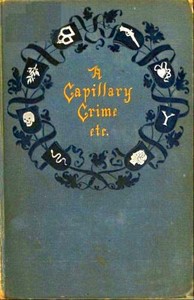
A Capillary Crime, and Other Stories — Story, Setting & Ideas can be approached with a clearer sense of reading commitment from its source measurements: 52,562 words, 3 hr 49 min estimated reading time, and 5 detected text sections.
The text analysis averages about 27.3 words per sentence, while the detected sections provide another way to judge how the source is divided.
Project Gutenberg metadata also associates the work with “Short stories, American,” connecting these edition facts with the source record’s subject description.
Explore this collection
These alternatives are selected using recorded categories and estimated reading time.
About 225 minutes
Historical Psychological Social Fiction
51,570 recorded words. 4 minutes difference from this book's estimate.
View Gutenberg source #24822About 222 minutes
Historical Psychological Social Fiction
51,047 recorded words. 7 minutes difference from this book's estimate.
View Gutenberg source #33525About 219 minutes
Historical Psychological Social Fiction
50,228 recorded words. 10 minutes difference from this book's estimate.
View Gutenberg source #74993Search stored excerpts and compare books → Choose by your preferences →
Choices use stored catalog measurements. Estimates vary with reading speed. A shared category is a catalog label, not a claim that two books have the same argument or literary quality.
Search reads excerpt text stored with this catalog and links to its associated Gutenberg record. The connection is stored in the site database; this tool does not recheck that every excerpt is word-for-word identical to that external record. Excerpt search does not cover every chapter and does not verify historical publication dates.
Catalog snapshot checked: 2026-09-25. Coverage: 93 public books, 93 available source excerpts.
Calculated from edition completeness, EPUB availability, text structure and catalogue metadata. Not a user rating.
Total of 100 points, scaled to a 2.5-5.0 range. Editions with an empty description or a missing EPUB file are not scored.
Public-domain source text
The source text is kept in the dedicated reader, separate from this catalogue record and its commentary.
The first story, “A Capillary Crime,” begins not with a crime but with a street: a quiet Montmartre lane where grass grows between paving stones and the only sounds are the glazier’s cry and the farmer’s call. Millet devotes nearly a page to this setting—its morning clatter, its afternoon gossip, its two lanterns swinging at night—before any character appears. This unhurried, almost topographic opening establishes a method that recurs throughout the collection: the physical world is rendered with such care that it becomes a character in its own right.
The excerpt from “Medusa’s Head” shifts to a coastal cliff, where the narrator descends a dangerous face to reach a cave. Again, the focus is on the material—the rubble, the crevices, the artificially made holes—and on the risk of discovery by a guard with a telescope. Millet’s narrators are often observers and collectors, and the stories reward attention to how they move through and describe their environments.
The opening of “A Capillary Crime” is a lesson in how to read Millet’s fiction. The street is described with the precision of a painter—its incline, its paving stones, its garden walls—and then populated with sounds: the glazier’s “Vi-i-i-tri-er!” and the farmer’s “À la crème, fromage à la crème!” These details are not decorative; they establish a rhythm of quiet and interruption that the story will follow. The narrator notes that Montmartre “remains to-day much the same as it was fifty years ago,” a remark that hints at the tension between the modern city and its older, hidden corners. When the story’s title event occurs, it will do so in a space already charged with the ordinary and the strange.
In “Medusa’s Head,” the narrator’s climb down a cliff is described step by step: “kicking and pushing the rubble,” “putting my fingers in the crevices,” testing each hold before committing. The physical effort is matched by the risk of being seen by the guard, whose telescope sweeps the beach. Once inside the cave, the narrator finds evidence of earlier excavators—Italian antiquarians—and begins to dig. The discovery of tesserae, small glass cubes with “beautiful iridescent” surfaces, is presented as both archaeological find and aesthetic pleasure. The narrator admits that “not a little of the charm” came from the danger of being caught. This blend of risk, labor, and reward is typical of Millet’s protagonists, who are often artists or collectors drawn to hidden things.
Millet was himself a painter, and his stories frequently feature artists or studios. The table of contents lists “Appearance of Mandel’s Studio the Morning After His Death” as an illustration, and the title story likely revolves around a studio setting. The excerpts show a narrator who notices textures—the “corroded surface” of glass, the “disintegrated rock” in the cave—and who values objects for their visual and historical interest. This attention to material detail extends to the way characters interact with their surroundings: they dig, they climb, they observe. The stories reward readers who pay similar attention to the physical world Millet constructs, where a street’s incline or a cave’s alcove can carry as much weight as any character’s motive.
The excerpts offer only fragments of each story’s arc. In “A Capillary Crime,” the crime itself is not described; in “Medusa’s Head,” the narrator leaves the cave without entering fully, returning later. Millet’s method is to build a world so thoroughly that the reader senses the larger story beyond the visible. The guard’s telescope, the Italian antiquarians’ abandoned pits, the studio left after death—these are thresholds. The stories do not always cross them. This restraint is a strength: the reader is left with the texture of the ordinary and the hint of something more, like the iridescent tesserae hidden beneath a corroded surface.
As you read, note how Millet uses physical spaces—a street, a cave, a studio—to create atmosphere and tension. The stories reward patience with description; the plot often emerges from the accumulation of sensory detail. Pay attention to what is not said, to the gaps and silences, and to the objects that characters handle with care. These are the clues to Millet’s method, and to the quiet dramas he stages in the corners of the everyday.
That rainy afternoon, I kept returning to the hill no horse could climb, feeling the damp stone through the page. Later, restless, I stumbled upon another collection—quieter, domestic—and found the same attentiveness to small rooms and unfinished lives. The Queen's Twin and Other Stories — A Reader’s Guide felt like a familiar hand in a different dusk.
Your answers remain private and are stored only in this browser.