About 222 minutes
Stories from Tagore — Context and Discussion
Historical Psychological Social Fiction
51,047 recorded words. 3 minutes difference from this book's estimate.
View Gutenberg source #33525
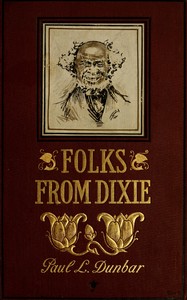
Folks from Dixie — Key Ideas to Explore can be approached with a clearer sense of reading commitment from its source measurements: 50,228 words, 3 hr 39 min estimated reading time, and 15 detected text sections.
The text analysis averages about 17.2 words per sentence, while the detected sections provide another way to judge how the source is divided.
Project Gutenberg metadata also associates the work with “Short stories, American,” connecting these edition facts with the source record’s subject description.
Explore this collection
These alternatives are selected using recorded categories and estimated reading time.
About 222 minutes
Historical Psychological Social Fiction
51,047 recorded words. 3 minutes difference from this book's estimate.
View Gutenberg source #33525About 225 minutes
Historical Psychological Social Fiction
51,570 recorded words. 6 minutes difference from this book's estimate.
View Gutenberg source #24822About 229 minutes
Historical Psychological Social Fiction
52,562 recorded words. 10 minutes difference from this book's estimate.
View Gutenberg source #62030Search stored excerpts and compare books → Choose by your preferences →
Choices use stored catalog measurements. Estimates vary with reading speed. A shared category is a catalog label, not a claim that two books have the same argument or literary quality.
Search reads excerpt text stored with this catalog and links to its associated Gutenberg record. The connection is stored in the site database; this tool does not recheck that every excerpt is word-for-word identical to that external record. Excerpt search does not cover every chapter and does not verify historical publication dates.
Catalog snapshot checked: 2026-09-25. Coverage: 93 public books, 93 available source excerpts.
Calculated from edition completeness, EPUB availability, text structure and catalogue metadata. Not a user rating.
Total of 100 points, scaled to a 2.5-5.0 range. Editions with an empty description or a missing EPUB file are not scored.
Public-domain source text
The source text is kept in the dedicated reader, separate from this catalogue record and its commentary.
The first story, “Anner ’Lizer’s Stumblin’ Block,” opens with a detached, almost painterly description of a Kentucky plantation in winter: “the gray old mansion … wrapped in its usual mantle of winter sombreness,” and the cabins of the enslaved forming “a long, broken black line.” The narrator quickly narrows to one cabin, then to Anner ’Lizer herself, described through a series of physical comparisons (“black eyes were like glowing coals,” “teeth were like twin rows of shining ivories”). This layered zoom—from landscape to community to individual—establishes a pattern of close observation that recurs across the collection.
Dunbar’s prose here is notably free of dialect in the expository passages, reserving vernacular speech for dialogue and later for embedded tales. The effect is a controlled, almost ethnographic distance that contrasts with the intimate voices that follow.
The opening paragraphs of “Anner ’Lizer’s Stumblin’ Block” demonstrate a deliberate narrative architecture: the story begins with a wide view of the Selfridge estate, then moves to the line of cabins, then to a single cabin “as dark and uninviting as the rest,” and finally to the heroine inside. This descent from general to specific is not merely descriptive; it signals that the collection will attend to individual lives within a larger social geography. The narrator’s eye is precise about material conditions—the “scrap limestone” chimney, the “unwhitewashed fronts”—but also about social hierarchy: Anner ’Lizer is “conceded to be the belle” among the “black, brown, or yellow” girls. The phrase “conceded to be” hints at competition and consensus, a small social drama embedded in the exposition.
Later in the collection, the narrative voice changes markedly. In the excerpt from a story involving Mas’ Tho’nton and Miss Nellie, the tale is told by a first-person speaker using heavy dialect: “Well, honey, dey ain’t no tellin’ whut Mas’ Jack’s plans was.” This shift from third-person description to oral storytelling is a structural feature of the book. The dialect speaker—often an older woman, like Aunt Emmerline—becomes the authority on past events, interpreting motives and emotions that the earlier narrator only observed from outside. For instance, the speaker notes that Mas’ Jack “shet hisse’f up an’ hit was th’ee days befo’ anybody ’cept me seed him,” a detail that would be inaccessible to a detached narrator. The reader must adjust to this change in register and perspective, which recurs across several stories.
Several motifs appear across the excerpts. Whiteness is repeatedly emphasized: the winter landscape is “unflecked whiteness,” and Miss Nellie is described as “all white an’ gentle lak a little dove.” This visual contrast between white and black surfaces is tied to social boundaries. The act of watching is also prominent: Mas’ Jack watches his son “ez he went erroun’ de house lak he was a baby yit,” and the narrator of the later story observes Mas’ Tho’nton’s hidden unhappiness. Separation—whether by class, race, or parental decree—drives the plots. In the opening story, Sam Merritt’s courtship of Anner ’Lizer is interrupted; in the later one, Mas’ Jack tries to keep his son from Miss Nellie. These repeated patterns suggest that the collection as a whole examines how individuals navigate enforced distances.
The list of illustrations by E. W. Kemble offers a visual counterpart to the stories’ focus on character and setting. Titles such as “A Visit from Uncle Eben,” “Brother Hezekiah Sneedon,” and “Old Aunt Doshy” indicate that the images, like the text, center on named individuals rather than generic scenes. The frontispiece, “Mr. Ruggles,” suggests a figure of some importance, though the table of contents does not list a story by that title—perhaps a character within one of the twelve tales. Kemble’s illustrations were a common feature in period fiction of this kind, and their presence here reinforces the book’s emphasis on portraiture and social observation. Readers may wish to note how the images align with or depart from the verbal descriptions.
Because the excerpts come from the beginning and middle of the collection, they reveal only part of Dunbar’s range. The later stories may continue or subvert the patterns established here. Readers attentive to shifts in narrative voice—from the measured third person of the opening to the intimate dialect of the embedded tale—will find a collection that experiments with perspective and authority. The recurring motifs of whiteness, watching, and separation offer a thread to follow across the twelve stories, even without knowledge of their individual resolutions.
Reading Folks from Dixie again, I kept noticing how Dunbar’s stories feel like voices carried on a porch breeze—each one slipping closer to the way folks actually talk. That plain, spoken quality lingers. It’s the same ache I found later in The Queen of Spades, and other stories — Key Ideas to Explore, where every silence seems to hold something unspoken. Some books just stay with you like that.
Use these questions to collect your thoughts before moving on.