About 371 minutes
The eternal masculine — Key Ideas to Explore
Historical Psychological Social Fiction
85,269 recorded words. 184 minutes difference from this book's estimate.
View Gutenberg source #71145
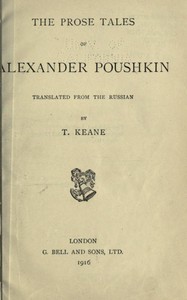
The Prose Tales of Alexander Pushkin — Reading Notes can be approached with a clearer sense of reading commitment from its source measurements: 127,635 words, 9 hr 15 min estimated reading time, and 15 detected text sections.
The text analysis averages about 16.2 words per sentence, while the detected sections provide another way to judge how the source is divided.
Project Gutenberg metadata also associates the work with “Russia -- Social life and customs -- Fiction,” connecting these edition facts with the source record’s subject description.
Explore this collection
These alternatives are selected using recorded categories and estimated reading time.
About 371 minutes
Historical Psychological Social Fiction
85,269 recorded words. 184 minutes difference from this book's estimate.
View Gutenberg source #71145About 357 minutes
Historical Psychological Social Fiction
82,034 recorded words. 198 minutes difference from this book's estimate.
View Gutenberg source #56878About 314 minutes
Historical Psychological Social Fiction
72,101 recorded words. 241 minutes difference from this book's estimate.
View Gutenberg source #63025Search stored excerpts and compare books → Choose by your preferences →
Choices use stored catalog measurements. Estimates vary with reading speed. A shared category is a catalog label, not a claim that two books have the same argument or literary quality.
Search reads excerpt text stored with this catalog and links to its associated Gutenberg record. The connection is stored in the site database; this tool does not recheck that every excerpt is word-for-word identical to that external record. Excerpt search does not cover every chapter and does not verify historical publication dates.
Catalog snapshot checked: 2026-09-25. Coverage: 93 public books, 93 available source excerpts.
Calculated from edition completeness, EPUB availability, text structure and catalogue metadata. Not a user rating.
Total of 100 points, scaled to a 2.5-5.0 range. Editions with an empty description or a missing EPUB file are not scored.
Public-domain source text
The source text is kept in the dedicated reader, separate from this catalogue record and its commentary.
Pushkin's prose in this collection moves with a deliberate, almost conversational ease, yet it is laced with a dry irony that undercuts any sentimentality. In 'The Captain's Daughter,' the narrator's account of his French tutor Beaupré—a hairdresser turned soldier turned teacher—is delivered with a deadpan humor that reveals the gap between the family's pretensions and reality. The translation by T. Keane captures this tonal precision, allowing Pushkin's voice to oscillate between the matter-of-fact and the subtly mocking.
Pushkin often embeds his sharpest observations within seemingly straightforward domestic scenes. In the opening of 'The Captain's Daughter,' the narrator describes his father's decision to hire a French tutor: 'Beaupré had been a hairdresser in his own country, then a soldier in Prussia, then he had come to Russia pour être outchitel.' The casual listing of failed careers, followed by the untranslated French phrase, exposes the absurdity of importing foreign education. The servant Savelitch's muttered complaint—'the child is washed, combed, and well-fed. What need is there for spending money and engaging a Mossoo?'—grounds the satire in a practical, skeptical voice. Pushkin lets the humor arise from the collision of social aspiration and mundane reality, never forcing a punchline.
In 'Doubrovsky,' a visit to Prince Vereisky's estate becomes a carefully choreographed display of wealth and taste. The description of the 'stone manor-house built in the style of an English castle' and the 'Swiss cows tinkling their bells' signals a world where nature itself is curated. Pushkin's narrator notes that the Prince 'did not speak of pictures in the pretentious language of the pedantic connoisseur, but with feeling and imagination.' This distinction between genuine appreciation and affected expertise is a recurring concern. The evening fireworks—'different coloured fires blazed up, whirled round, rose up in sheaves'—serve as a literal spectacle of control, while Maria Kirilovna's 'girlish curiosity' about a mysterious inscription hints at the limits of this managed experience. The passage balances admiration for the aesthetic with an awareness of its constructedness.
Pushkin's narrators often maintain a cool distance, yet they occasionally allow moments of psychological closeness that complicate the reader's judgment. In 'Doubrovsky,' Maria Kirilovna is observed 'embroidering at her frame before the open window,' her thoughts 'far away' despite her hands working 'unerringly.' The simile comparing her to 'Conrad's mistress, who, in her amorous distraction, embroidered a rose with green silk' introduces a literary parallel that both elevates and gently mocks her distraction. The narrator refrains from explaining her feelings, leaving the reader to infer the tension between her outward composure and inner life. This technique—presenting action without commentary—forces attention to the gaps between what characters do and what they feel, a hallmark of Pushkin's narrative craft.
Readers approaching this collection should attend to the tonal shifts between stories: the same voice that delivers a wry account of a provincial education can, in the next tale, describe a fireworks display with genuine wonder. Pushkin's prose rewards attention to small details—a muttered complaint, a misapplied French phrase, a character's unspoken thought—that accumulate into a layered portrait of Russian society. The translation by T. Keane, while early twentieth-century in style, preserves these nuances without flattening them.
I keep returning to the dry, sidelong wit in Pushkin’s prose, that way it undercuts every grand romantic gesture with a quiet, almost paternal shrug. It makes me think of the softer, unexamined spaces in The eternal masculine — Key Ideas to Explore, and how we rarely talk about the tenderness that hides beneath our irony. Strange, how a nineteenth-century voice still feels like a friend.
Answer a few questions and save a private reflection on this device.