About 357 minutes
First love, and other stories — Themes and Context
Historical Psychological Social Fiction
82,034 recorded words. 14 minutes difference from this book's estimate.
View Gutenberg source #56878
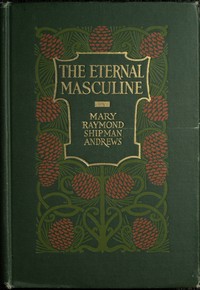
The source record for The eternal masculine — Key Ideas to Explore measures this digital text at 85,269 words, 6 hr 11 min estimated reading time, and 18 detected text sections.
The text analysis averages about 16.1 words per sentence, while the detected sections provide another way to judge how the source is divided.
Project Gutenberg metadata also associates the work with “Short stories, American,” connecting these edition facts with the source record’s subject description.
Explore this collection
These alternatives are selected using recorded categories and estimated reading time.
About 357 minutes
Historical Psychological Social Fiction
82,034 recorded words. 14 minutes difference from this book's estimate.
View Gutenberg source #56878About 314 minutes
Historical Psychological Social Fiction
72,101 recorded words. 57 minutes difference from this book's estimate.
View Gutenberg source #63025About 283 minutes
Historical Psychological Social Fiction
64,906 recorded words. 88 minutes difference from this book's estimate.
View Gutenberg source #61194Search stored excerpts and compare books → Choose by your preferences →
Choices use stored catalog measurements. Estimates vary with reading speed. A shared category is a catalog label, not a claim that two books have the same argument or literary quality.
Search reads excerpt text stored with this catalog and links to its associated Gutenberg record. The connection is stored in the site database; this tool does not recheck that every excerpt is word-for-word identical to that external record. Excerpt search does not cover every chapter and does not verify historical publication dates.
Catalog snapshot checked: 2026-09-25. Coverage: 93 public books, 93 available source excerpts.
Calculated from edition completeness, EPUB availability, text structure and catalogue metadata. Not a user rating.
Total of 100 points, scaled to a 2.5-5.0 range. Editions with an empty description or a missing EPUB file are not scored.
Public-domain source text
The source text is kept in the dedicated reader, separate from this catalogue record and its commentary.
The collection opens with a dedication that defines its lens: 'in most men worth considering there appears to be, from three to ninety, an ineradicable boyhood.' The first story, 'The Scarlet Ibis,' immediately grounds this idea in sensory detail—a boy on a portage who 'stopped sharply' at a sound his guide Josef had already heard. The guide stands 'rooted in the path, a line of lean strength,' his scarlet bandanna 'pricking the dim light.' This precision of observation, where a single color punctuates a muted landscape, sets the tone for stories that hinge on small, telling gestures.
The nine tales range from wilderness adventure to urban intervention. In 'The Whistling of Zoëtique,' a first-person narrator—a man of forty—describes extricating a young French-Canadian whistler from a New York vaudeville contract. The excerpt shows the narrator's internal debate: 'a meteoric vaudeville success did not seem to me worth while as I thought of those things.' The story balances the boy's sophisticated urban ease with his longing for a lost canoe trip, captured in a photograph that 'wings the spirit.'
The book's front matter is not merely ceremonial. Andrews dedicates the volume to a 'splendid phalanx of young Americans, lately boys in years, graduates of Yale'—fourteen named men, plus unnamed others from Kentucky, the West, the crowded city. This list signals that the stories will examine boyhood as a persistent quality, not a stage to outgrow. The dedication's phrasing—'between the lines of the names below'—invites the reader to see each tale as a variation on that theme. The first story's wilderness setting, with its precise details of portage and canoe, establishes a physical world where boyish alertness matters. Later, 'The Whistling of Zoëtique' shifts to a New York apartment, but the same core tension appears: a young man's primitive delight in a photograph of himself poling a canoe versus his acquired taste for taxicabs. The dedication thus functions as a compass, pointing toward the recurring question of what constitutes authentic manhood.
The excerpts reveal two distinct narrative voices. 'The Scarlet Ibis' uses a close third person, tracking the boy's perceptions: 'Light as the sound was, quickly as the boy had heard it, Josef had heard first.' The prose is lean, favoring action and sensory detail over interior monologue. In contrast, 'The Whistling of Zoëtique' employs a first-person narrator who is self-aware and reflective: 'as I sat smoking alone at three in the morning in a twelfth-story New York apartment, I elected to be guardian angel to this backwoods boy.' This narrator's voice carries a wry, paternal tone—he calls himself a 'Dutch uncle'—and he explicitly weighs choices: a log cabin and a wife versus vaudeville fame. The shift in voice suggests that the collection experiments with distance: some stories observe boyhood from outside, others from inside a man's memory. Readers may note how the narrator's age and relation to the boy character shape the story's moral weight.
Certain objects recur across the excerpts, linking the stories visually. In 'The Scarlet Ibis,' Josef wears a 'scarlet bandanna' at his belt. In 'The Whistling of Zoëtique,' the young whistler Zoëtique has a bandanna 'about his throat' in the canoe photograph. The color red—scarlet, bandanna—appears as a marker of vitality against muted backgrounds. Canoes also bridge the tales: the first story's portage implies a canoe; the later story explicitly describes a photograph of Zoëtique 'standing upright in the stern of the canoe, poling it through the shallows.' The photograph itself becomes a talisman: it 'wings the spirit' and triggers Zoëtique's emotional collapse. Andrews uses these repeated props to create a shared visual vocabulary. Readers encountering a bandanna or a canoe in later stories may recognize it as a signal of the 'ineradicable boyhood' the dedication promises. The details are never merely decorative; they carry the weight of memory and choice.
'The Whistling of Zoëtique' presents a clear ethical dilemma: should the narrator send the young whistler back to the wilderness or let him pursue a lucrative vaudeville career? The narrator's reasoning is practical and protective: 'self-respect and normal life waiting there for him, and a meteoric vaudeville success did not seem to me worth while.' He negotiates with the boy's manager, Charles Esmond, who reluctantly agrees: 'Take your brat and ship him back, or I'll change my mind.' The story does not show the outcome—the excerpt ends before Zoëtique's decision—but the narrator's confidence suggests a paternalistic worldview. This pattern of an older man guiding a younger one may recur in other stories. The catalog subjects ('Boys -- Fiction; Men -- Fiction') and the dedication's emphasis on Yale graduates hint at a network of mentorship. Readers should watch for moments where a character's future is decided by another's intervention, and note whether the stories endorse or complicate that authority.
These nine stories reward attention to small physical details—the weight of a paddle, the color of a bandanna, the angle of a photograph. Andrews builds her themes not through abstract statement but through concrete choices made by characters in specific landscapes. The excerpts offer only fragments of the whole, but they suggest a collection unified by its dedication to a persistent boyhood. As you read, track how each story answers the question posed by the narrator of 'The Whistling of Zoëtique': what is worth saving, and at what cost?
The rain drummed against the window that afternoon, and I kept returning to the quiet ache in those nine stories—how boyhood never really leaves a man. That thought lingered long after I closed the book. Later, almost by accident, my hand found The Queen's Twin and Other Stories — A Reader’s Guide, and it felt like the same tender weather, just a different season of it.
Create a short personal record of your experience with this book.