About 179 minutes
By Reef and Palm — Inside the Classic
Historical Psychological Social Fiction
41,063 recorded words. 11 minutes difference from this book's estimate.
View Gutenberg source #3818
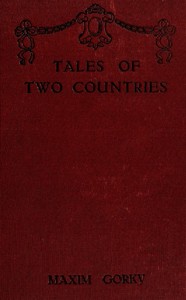
For Tales of Two Countries — Text and Context, the stored edition analysis reports 43,671 words, 3 hr 10 min estimated reading time, and 5 detected text sections.
The text analysis averages about 17.4 words per sentence, while the detected sections provide another way to judge how the source is divided.
Project Gutenberg metadata also associates the work with “Russia -- Social life and customs -- Fiction,” connecting these edition facts with the source record’s subject description.
Explore this collection
These alternatives are selected using recorded categories and estimated reading time.
About 179 minutes
Historical Psychological Social Fiction
41,063 recorded words. 11 minutes difference from this book's estimate.
View Gutenberg source #3818About 209 minutes
Historical Psychological Social Fiction
47,881 recorded words. 19 minutes difference from this book's estimate.
View Gutenberg source #73663About 163 minutes
Historical Psychological Social Fiction
37,428 recorded words. 27 minutes difference from this book's estimate.
View Gutenberg source #307Search stored excerpts and compare books → Choose by your preferences →
Choices use stored catalog measurements. Estimates vary with reading speed. A shared category is a catalog label, not a claim that two books have the same argument or literary quality.
Search reads excerpt text stored with this catalog and links to its associated Gutenberg record. The connection is stored in the site database; this tool does not recheck that every excerpt is word-for-word identical to that external record. Excerpt search does not cover every chapter and does not verify historical publication dates.
Catalog snapshot checked: 2026-09-25. Coverage: 93 public books, 93 available source excerpts.
Calculated from edition completeness, EPUB availability, text structure and catalogue metadata. Not a user rating.
Total of 100 points, scaled to a 2.5-5.0 range. Editions with an empty description or a missing EPUB file are not scored.
Public-domain source text
The source text is kept in the dedicated reader, separate from this catalogue record and its commentary.
Gorky's Tales of Two Countries opens with a striking structural division: the book is split into Italian and Russian sections, each containing stories that mirror and challenge one another. The first tale, 'Man and the Simplon,' immediately establishes a pattern of contrasting images—the serene blue lake and snow-capped mountains against the dark, laboring figure of a workman who speaks of the earth's 'hot breath' and the fear of tunneling. This juxtaposition of natural beauty and human toil recurs throughout, as does the motif of bodies marked by their environment: the workman's medal, the hunchback's deformed frame, the old woman's aquiline profile. Gorky's prose moves between expansive landscapes and cramped interiors, between the collective labor of the Simplon tunnel and the isolated grotesquerie of a Dutch brother and sister. These shifts in scale and setting form the book's central tension.
In the Italian tales, Gorky repeatedly renders landscape with a tactile intensity that borders on the animate. The Simplon road is 'a grey ribbon' that 'thrusts into the quiet mountain gorge,' while the lake is 'deeply set in mountains capped with eternal snow.' These descriptions are not mere backdrops; they participate in the narrative. The workman attributes a kind of sentience to the earth, claiming it 'must have some feeling' because it 'breathed a hot breath' on the tunnelers. This personification extends to the gardens that 'descend in gorgeous folds' and the sun that is 'new risen.' By contrast, the Russian tales—though less represented in the excerpts—likely employ a different register, perhaps more austere or claustrophobic. The structural alternation between countries invites readers to compare how each environment shapes its inhabitants' voices and struggles.
Gorky's characters are often defined by their physicality, especially their deformities or marks of labor. The workman on the Simplon wears a medal 'on his breast' and sits 'like some dark coloured beetle,' his sunburnt hands resting on his knees. Later, the hunchback is described in excruciating detail: his 'square body,' 'large, heavy, forward-hanging head,' 'weak mouth half open,' and 'sparse and wiry' moustache. His sister, the tall old woman, has a 'grey wart' on her chin and eyes 'hidden so deep that the woman appears almost blind.' These grotesque portraits are not gratuitous; they reflect the social and psychological pressures that have shaped these figures. The hunchback's childhood passivity—'he never ran away from her and never complained'—suggests a history of abuse that has calcified into a permanent posture. Gorky uses physical description as a shorthand for biography, making the body a text to be read.
Dialogue in the excerpts is sparse but weighted. The workman's monologue about the Simplon tunnel is delivered in a conversational, almost confiding tone: 'Oh, every kind of work is hard for a time, until you get used to it.' His words are interspersed with pauses and gestures—'he shook his head a little, smiling at the sun'—that give the speech a rhythmic, oral quality. In contrast, the Dutch siblings are introduced through silence and observation. The hunchback's sister 'walks as firmly as a soldier,' her lips 'tightly compressed, as if she had just said: "No!"' The narrative itself shifts between these modes: expansive, lyrical passages describing nature, and tight, clinical descriptions of characters. This alternation mirrors the book's larger structure, where Italian tales may favor open-air dialogue and Russian tales perhaps lean toward interior monologue or constrained speech. The reader is asked to attend not only to what is said but to the spaces between words.
Light functions as a moral and atmospheric cue throughout the excerpts. The Italian morning is bathed in gentle light: 'the dew still glistens on the leaves,' 'the sun is new risen.' The workman's medal 'glistens' as he smiles. But this brightness is undercut by the 'dark network of gardens' and the 'dark coloured beetle' of the workman himself. In the hotel scene, the sunbeams form a 'web' through which the old woman walks, tapping her sunshade 'on the noisy pavement.' The hunchback's opal is described as 'an unlucky stone,' and his presence makes 'everything seem to grow dark and dim.' Gorky uses light to signal shifts in mood and power: the workman's labor is illuminated by the sun, while the wealthy Dutch characters cast a pall. This motif of chiaroscuro—the play of brightness and obscurity—unifies the collection, suggesting that no landscape, whether Italian or Russian, is free from shadow.
Readers approaching Tales of Two Countries will benefit from attending to the book's deliberate structural pairing. Each Italian story may be read as a counterpoint to a Russian one, not in plot but in mood and method. Gorky's eye for the grotesque and his ear for the rhythms of labor and silence reward slow reading. Notice how the same descriptive intensity applied to a mountain pass is turned on a hunchback's face; the book's unity lies in its unwavering gaze at what is difficult to see.
I finished Tales of Two Countries the other week, and it stayed with me—how light and labor shift meaning between Italy and Russia, yet the weight of ordinary bodies feels so familiar. It reminded me of how A Capillary Crime, and Other Stories — Story, Setting & Ideas handles that same quiet ache in its own settings. Somehow, both leave a gentler imprint than their darkness suggests.
Build a private reading journal entry for this title.