About 246 minutes
The Amouretta landscape, and other stories — A Closer Reading
Fantasy Juvenile Worlds
56,426 recorded words. 8 minutes difference from this book's estimate.
View Gutenberg source #75047
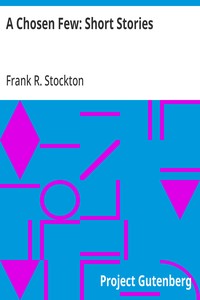
This digital edition of A Chosen Few: Short Stories — Reading Companion is described by source-level measurements including 58,341 words, 4 hr 14 min estimated reading time, and 9 detected text sections.
The text analysis averages about 19.3 words per sentence, while the detected sections provide another way to judge how the source is divided.
Project Gutenberg metadata also associates the work with “Short stories, American,” connecting these edition facts with the source record’s subject description.
Explore this collection
These alternatives are selected using recorded categories and estimated reading time.
About 246 minutes
Fantasy Juvenile Worlds
56,426 recorded words. 8 minutes difference from this book's estimate.
View Gutenberg source #75047About 293 minutes
Fantasy Juvenile Worlds
67,269 recorded words. 39 minutes difference from this book's estimate.
View Gutenberg source #64242About 200 minutes
Fantasy Juvenile Worlds
45,848 recorded words. 54 minutes difference from this book's estimate.
View Gutenberg source #46366Search stored excerpts and compare books → Choose by your preferences →
Choices use stored catalog measurements. Estimates vary with reading speed. A shared category is a catalog label, not a claim that two books have the same argument or literary quality.
Search reads excerpt text stored with this catalog and links to its associated Gutenberg record. The connection is stored in the site database; this tool does not recheck that every excerpt is word-for-word identical to that external record. Excerpt search does not cover every chapter and does not verify historical publication dates.
Catalog snapshot checked: 2026-09-25. Coverage: 93 public books, 93 available source excerpts.
Calculated from edition completeness, EPUB availability, text structure and catalogue metadata. Not a user rating.
Total of 100 points, scaled to a 2.5-5.0 range. Editions with an empty description or a missing EPUB file are not scored.
Public-domain source text
The source text is kept in the dedicated reader, separate from this catalogue record and its commentary.
Frank R. Stockton's A Chosen Few opens with a preface that frames the collection as the result of a 'literary civil-service examination'—a characteristically wry self-assessment. The stories gathered here, published between 1882 and 1895, share a distinctive narrative voice: one that presents extraordinary events with the calm, measured tone of a report. In 'Negative Gravity,' the narrator describes a walk 'along a hard, smooth highway' before scaling a four-foot wall, only to encounter a phenomenon that defies physics. Stockton's prose never strains for effect; the fantastic is delivered with the same matter-of-fact clarity as the mundane.
Stockton's genius lies in his ability to treat outlandish concepts with the gravity of a scientific paper. In 'Negative Gravity,' the narrator's wife acquires the power to become weightless, yet the story's tension derives not from the miracle itself but from the practical inconveniences it causes. The author's preface reveals that this story was 'composed in Switzerland when the author was temporarily confined to the house in full view of unreachable Alps'—a biographical detail that underscores the playful origin of the idea. Similarly, 'The Remarkable Wreck of the “Thomas Hyke”' was born from a desire to invent 'some sort of shipwreck which had never yet been made the subject of a story.' Stockton's method is to take a single, absurd premise and follow its logical consequences with relentless precision, never winking at the reader.
Stockton's dialogue is spare but telling. In 'His Wife's Deceased Sister,' the conversational exchanges reveal unspoken tensions without explicit commentary. The author's preface notes that this story was 'suggested by an editorial disposition to compare all the author's work with one previous production'—a meta-commentary that echoes the story's own concern with comparison and expectation. The dialogue often carries the weight of psychological revelation, as characters speak around their true feelings. In 'The Lady, or the Tiger?,' the princess's internal conflict is rendered through indirect discourse: 'she had thought of nothing, night or day, but this great event.' Stockton's characters rarely declare their emotions; instead, their words and actions imply a complex interior life.
Physical barriers recur throughout the collection. In 'Negative Gravity,' the narrator and his wife 'easily scaled a wall about four feet high' to enter pasture-land. In 'The Lady, or the Tiger?,' the arena features 'twin doors—those fateful portals, so terrible in their similarity.' These thresholds are not merely scenic; they represent moments of decision and uncertainty. The princess knows 'the secret of the doors,' yet her knowledge only deepens the story's famous ambiguity. Stockton's walls and doors are never just obstacles—they are devices that force characters (and readers) to confront the limits of their knowledge. The author's preface acknowledges that 'The Lady, or the Tiger?' was written in the hope of receiving 'the cheerful coöperation of some of his readers in a satisfactory solution,' a hope that was met with 'a great deal of scolding.'
Stockton's prose is notable for its economy and clarity. Descriptions are functional yet vivid: the princess's lover is 'tall, beautiful, fair,' and the crowd responds with 'a low hum of admiration and anxiety.' The narrator of 'Negative Gravity' notes the 'hard, smooth highway' and 'light fences of reed or cane' with the same detached observation he applies to the story's central marvel. This restraint extends to the handling of emotion. In 'The Lady, or the Tiger?,' the princess's hatred for the lady behind the door is conveyed through a series of measured clauses: 'the girl was lovely, but she had dared to raise her eyes to the loved one of the princess.' Stockton trusts his readers to infer the intensity of feeling from the accumulation of detail, never resorting to melodrama.
Readers approaching A Chosen Few will find a collection that rewards attention to narrative craft. Stockton's stories are not driven by plot twists alone; they are exercises in tone, structure, and the management of expectation. The author's preface offers a rare glimpse into his creative process, revealing the specific circumstances and provocations that gave rise to each tale. To read these stories is to watch a master of the short form at work—one who understood that the most fantastic premises require the most disciplined execution.
There’s a moment in Stockton’s stories where a wild idea is carried forward with such calm, deadpan logic that the ordinary world tilts sideways. I remembered that feeling while reading Down the Ice, and Other Winter Sports Stories — Story, Setting & Ideas. Those wintry games hold the same quiet, precarious delight—wonder taken seriously, as if the frozen pond itself were a private experiment.
Capture what you thought, learned, and would like to remember.