About 415 minutes
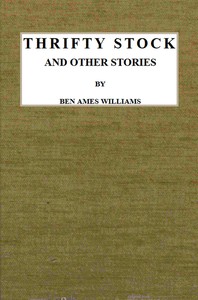
Thrifty Stock, and Other Stories — Reading Notes
Fantasy Juvenile Worlds
95,266 recorded words. 17 minutes difference from this book's estimate.
View Gutenberg source #63184

For Not Pretty, but Precious; And Other Short Stories — Themes and Context, the stored edition analysis reports 99,283 words, 7 hr 12 min estimated reading time, and 10 detected text sections.
The text analysis averages about 21.0 words per sentence, while the detected sections provide another way to judge how the source is divided.
Project Gutenberg metadata also associates the work with “Short stories, American,” connecting these edition facts with the source record’s subject description.
Explore this collection
These alternatives are selected using recorded categories and estimated reading time.
About 415 minutes
Fantasy Juvenile Worlds
95,266 recorded words. 17 minutes difference from this book's estimate.
View Gutenberg source #63184About 378 minutes
Fantasy Juvenile Worlds
86,837 recorded words. 54 minutes difference from this book's estimate.
View Gutenberg source #59050About 489 minutes
Fantasy Juvenile Worlds
112,376 recorded words. 57 minutes difference from this book's estimate.
View Gutenberg source #24878Search stored excerpts and compare books → Choose by your preferences →
Choices use stored catalog measurements. Estimates vary with reading speed. A shared category is a catalog label, not a claim that two books have the same argument or literary quality.
Search reads excerpt text stored with this catalog and links to its associated Gutenberg record. The connection is stored in the site database; this tool does not recheck that every excerpt is word-for-word identical to that external record. Excerpt search does not cover every chapter and does not verify historical publication dates.
Catalog snapshot checked: 2026-09-25. Coverage: 93 public books, 93 available source excerpts.
Calculated from edition completeness, EPUB availability, text structure and catalogue metadata. Not a user rating.
Total of 100 points, scaled to a 2.5-5.0 range. Editions with an empty description or a missing EPUB file are not scored.
Public-domain source text
The source text is kept in the dedicated reader, separate from this catalogue record and its commentary.
The collection's title story, "Not Pretty, but Precious," opens with a wife writing a letter to her husband, a man who married her out of convenience. The narrator's voice is measured and self-aware: she describes herself as a "poor, plain, brown-faced little school-teacher" and dissects the "horrible strangeness" of their union. This epistolary frame sets a pattern for the volume: many stories hinge on documents, confessions, or suppressed histories that surface years later.
In "The Red Fox," a colonel confronts a woman whose husband he once helped convict. Her monologue, rendered in dialect, reveals a buried legal document—an affidavit—that could overturn the past. The story ends with a quiet, almost pastoral image of the woman's son, now a landowner, smoking his pipe and remembering a "dazzling creature" who once rode by. These excerpts suggest a collection preoccupied with how the past is written, rewritten, or silently carried.
Several stories in this volume are built around written or spoken records that characters use to assert or revise truth. In "Not Pretty, but Precious," the wife's letter is a deliberate act of self-justification: she writes because she can say what she means "so much better on paper than in conversation." The letter becomes a tool for controlling how her husband perceives their marriage. Similarly, in "The Red Fox," the climax hinges on an affidavit—a sworn statement that a dying man signed, witnessed, and sealed with a judge's red seal. The woman who holds it says, "Could I go back an' show that paper'n tell how 'twas? Too late!" The document is both a weapon and a burden, kept safe but unused until the right moment.
These stories treat writing as a form of power, but also as something that can be withheld or delayed. The colonel in "The Red Fox" copies the confession before leaving, but the narrative does not show him using it. The reader is left to imagine whether the truth will ever be fully spoken.
The excerpts reveal a sharp contrast between the polished, introspective prose of the title story and the dialect-heavy speech of characters like Mrs. Ruggles in "The Red Fox." Her voice is rendered phonetically: "'Twas Christian in me. Some said I must ha' been a fool." This is not merely local color; the dialect marks her as someone outside the colonel's social world, and her story—of a husband wrongfully imprisoned—challenges his comfortable assumptions. The narrative does not soften her speech or translate it; it lets her words stand as a direct, unapologetic testimony.
Other stories in the collection may use similar techniques. "The Cold Hand" and "The Blood Seedling" are by Clara F. Guernsey and John Hay, respectively, and their titles suggest supernatural or gothic elements. But the excerpts available do not confirm whether those stories also employ dialect or class contrast. The volume as a whole, however, seems to place rural, working-class characters in dialogue with more educated or wealthy figures, often with moral consequences.
Two of the excerpted stories share a striking visual detail: a sickroom with moonlight falling on a bed. In "Not Pretty, but Precious," the husband is recovering from an accident; in "The Red Fox," the woman recalls her husband dying by a window where "the moon come in on his bed." The moonlight is not merely atmospheric—it becomes a site of memory and guilt. Mrs. Ruggles moves her bed to a darker corner because she feels "not good enough to lie there." The light itself seems to accuse.
These stories also share a reluctance to state emotions directly. The wife in the title story writes a long letter but never says she loves or hates her husband. Mrs. Ruggles vanishes "across the light to her dark place of rest" after speaking the word "truth." The colonel leaves without expressing his feelings. What is left unsaid—or written but not spoken aloud—carries as much weight as the dialogue. Readers should watch for similar silences in the other eight stories.
This collection rewards attention to its formal variety: epistolary fiction, dialect monologue, and third-person narration sit side by side. The catalog subject "Short stories, American" is accurate but generic; the excerpts suggest a more specific interest in legal and emotional documents, class friction, and the persistence of the past. Readers may wish to compare how different authors in the volume handle the same motifs—letters, moonlight, withheld truth—and note which stories break the pattern entirely.
There’s something moving about how these 1872 stories dwell in quiet reckonings—letters never sent, confessions half-spoken. Reading them feels like finding an old photograph in a drawer. I think of that same tender interiority when I revisit Atlantic Narratives: Modern Short Stories; Second Series — Context and Discussion; the voices change, but that hush, that patient listening, remains. Time passes, yet some echoes never quite fade.
Use these questions to collect your thoughts before moving on.