About 489 minutes
Lucy Maud Montgomery Short Stories, 1909 to 1922 — Reading Notes
Fantasy Juvenile Worlds
112,376 recorded words. 68 minutes difference from this book's estimate.
View Gutenberg source #24878
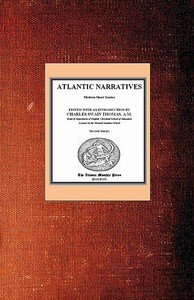
Before opening Atlantic Narratives: Modern Short Stories; Second Series — Context and Discussion, the edition data offers a quick orientation: 127,893 words, 9 hr 17 min estimated reading time, and 12 detected text sections.
The text analysis averages about 16.4 words per sentence, while the detected sections provide another way to judge how the source is divided.
Project Gutenberg metadata also associates the work with “Short stories,” connecting these edition facts with the source record’s subject description.
Explore this collection
These alternatives are selected using recorded categories and estimated reading time.
About 489 minutes
Fantasy Juvenile Worlds
112,376 recorded words. 68 minutes difference from this book's estimate.
View Gutenberg source #24878About 432 minutes
Fantasy Juvenile Worlds
99,283 recorded words. 125 minutes difference from this book's estimate.
View Gutenberg source #11392About 415 minutes
Fantasy Juvenile Worlds
95,266 recorded words. 142 minutes difference from this book's estimate.
View Gutenberg source #63184Search stored excerpts and compare books → Choose by your preferences →
Choices use stored catalog measurements. Estimates vary with reading speed. A shared category is a catalog label, not a claim that two books have the same argument or literary quality.
Search reads excerpt text stored with this catalog and links to its associated Gutenberg record. The connection is stored in the site database; this tool does not recheck that every excerpt is word-for-word identical to that external record. Excerpt search does not cover every chapter and does not verify historical publication dates.
Catalog snapshot checked: 2026-09-25. Coverage: 93 public books, 93 available source excerpts.
Calculated from edition completeness, EPUB availability, text structure and catalogue metadata. Not a user rating.
Total of 100 points, scaled to a 2.5-5.0 range. Editions with an empty description or a missing EPUB file are not scored.
Public-domain source text
The source text is kept in the dedicated reader, separate from this catalogue record and its commentary.
The twelve stories in this 1918 collection, drawn from the Atlantic Monthly, share a preoccupation with how characters navigate sudden upheaval—whether from war, migration, or personal crisis. Editor Charles Swain Thomas, in his introduction, frames the anthology as an effort to preserve “the choicest bits” of modern writing against a flood of print, but the stories themselves often resist easy categorization. They move between epistolary frames, interior monologue, and third-person narration, and several hinge on a withheld or delayed revelation.
World War I appears not as a single subject but as a force that reshapes characters’ priorities and perceptions. In Mary Antin’s “The Lie,” the narrator’s family gradually loses interest in the Russian immigrant Babanchik as war news consumes their attention: “we had lost interest in his stories.” The story tracks this erosion through small details—the doctor’s terse diagnosis, the delayed letter from Kolya. Other stories, like Joseph Husband’s “A Year in a Coal-mine” and Edward Morlae’s “A Soldier of the Legion,” treat war or its aftermath through the lens of labor and endurance, avoiding direct battle scenes. The collection thus presents war as a condition that alters everyday life rather than a spectacle.
Several stories return to images of physical or psychological enclosure. In “The Lie,” Babanchik’s son Kolya is imprisoned in Russia, and his petition to the Tsar to fight in the army becomes a bid for freedom. The story’s language of “prisons” and “vampire” Russia echoes through the excerpt. Similarly, in “The Purple Star” by Rebecca Hooper Eastman, the title suggests a symbol of hope or recognition, though the full context is not given. The motif of a character watching from a window—Manya waving a handkerchief—recurs, framing memory as a kind of confinement. These images tie the stories together without forcing a single theme.
Several stories rely on what is left unsaid. In “The Lie,” the family’s gradual neglect of Babanchik is revealed through the youngest brother’s observation: “I think we have all been blind—and stupid!” The narrative withholds Babanchik’s true concern until the delayed letter arrives. This technique of delayed disclosure appears in other stories as well. In “What Mr. Grey Said” by Margaret Prescott Montague, the title itself hints at a withheld statement. The collection’s structure—moving between stories that each hold back key information—invites readers to piece together motives from indirect clues, a method that rewards close attention.
The stories frequently shift between intimate domestic scenes and larger social or political contexts. In “The Lie,” the family’s home becomes a space where war news is read and discussed, but also where Babanchik’s quiet deterioration goes unnoticed. The doctor’s advice—“Keep him amused”—clashes with the family’s obsession with public events. Similarly, in “The Boulevard of Rogues” by Meredith Nicholson, the title suggests a public thoroughfare, while the story likely involves personal intrigue. This oscillation between private feeling and public event is a structural pattern across the anthology, with each story finding its own balance between interior and exterior worlds.
Readers approaching this collection will find it rewards attention to narrative structure and recurring imagery rather than plot summary. The stories are best read in sequence, as echoes between them—the figure of the immigrant, the pressure of war, the unspoken grief—accumulate. The biographical notes at the end provide context for each author, but the stories themselves stand as independent experiments in form, each with its own method of withholding and revealing.
That rainy afternoon, Atlantic Narratives kept circling back to soldiers coming home to rooms they no longer recognized. The quiet ache of that stuck with me, the way a familiar place can feel like someone else’s photograph. Later, half-awake, I reached for A Book — A Reader’s Guide, and found it answered that same loneliness—not with stories, but with the gentlest map of why we read them at all.
A brief reflection can help important ideas stay with you longer.