About 76 minutes
Tales of the turf — Text and Context
Fantasy Juvenile Worlds
17,479 recorded words. 10 minutes difference from this book's estimate.
View Gutenberg source #75271
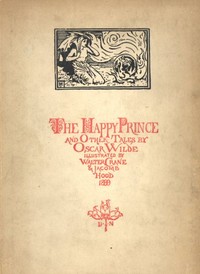
For The Happy Prince, and Other Tales — Reading Companion, the stored edition analysis reports 19,582 words, 1 hr 26 min estimated reading time, and 6 detected text sections.
The text analysis averages about 17.7 words per sentence, while the detected sections provide another way to judge how the source is divided.
Project Gutenberg metadata also associates the work with “Fairy tales,” connecting these edition facts with the source record’s subject description.
Explore this collection
These alternatives are selected using recorded categories and estimated reading time.
About 76 minutes
Fantasy Juvenile Worlds
17,479 recorded words. 10 minutes difference from this book's estimate.
View Gutenberg source #75271About 35 minutes
Fantasy Juvenile Worlds
7,987 recorded words. 51 minutes difference from this book's estimate.
View Gutenberg source #71065About 34 minutes
Fantasy Juvenile Worlds
7,749 recorded words. 52 minutes difference from this book's estimate.
View Gutenberg source #74142Search stored excerpts and compare books → Choose by your preferences →
Choices use stored catalog measurements. Estimates vary with reading speed. A shared category is a catalog label, not a claim that two books have the same argument or literary quality.
Search reads excerpt text stored with this catalog and links to its associated Gutenberg record. The connection is stored in the site database; this tool does not recheck that every excerpt is word-for-word identical to that external record. Excerpt search does not cover every chapter and does not verify historical publication dates.
Catalog snapshot checked: 2026-09-25. Coverage: 93 public books, 93 available source excerpts.
Calculated from edition completeness, EPUB availability, text structure and catalogue metadata. Not a user rating.
Total of 100 points, scaled to a 2.5-5.0 range. Editions with an empty description or a missing EPUB file are not scored.
Public-domain source text
The source text is kept in the dedicated reader, separate from this catalogue record and its commentary.
Oscar Wilde's The Happy Prince, and Other Tales opens with a statue admired for its beauty yet immediately undercut by a Town Councillor's pragmatic quibble: the Prince is 'as beautiful as a weathercock, only not quite so useful.' This tension between aesthetic perfection and practical value runs through the collection. Wilde's narrative voice shifts rapidly—from the Swallow's mock-heroic love for a Reed to the Mathematical Master's disapproval of dreaming—creating a layered, ironic tone that resists simple moralizing. The stories balance lyrical description with sharp social observation, as when the Happy Prince's tears reveal the suffering hidden beneath the city's glittering surface.
The opening of 'The Happy Prince' establishes Wilde's characteristic blend of fairy-tale form and worldly irony. The statue is praised by a mother who tells her crying son, 'The Happy Prince never dreams of crying for anything,' a line that becomes bitterly ironic as the Prince's tears flow. The Swallow's courtship of the Reed is rendered with deadpan humor: 'Shall I love you?' he asks, and the Reed makes 'a low bow.' Other swallows dismiss the attachment as 'ridiculous' because the Reed 'has no money, and far too many relations.' Wilde uses the Swallow's voice—practical, self-absorbed, yet capable of compassion—to introduce the collection's central concern: the conflict between self-interest and genuine care. The narrative pace quickens with the Swallow's decision to leave, then slows as he encounters the Prince's tears, marking a tonal shift from comedy to pathos.
In 'The Devoted Friend,' Wilde exposes exploitative relationships through the Miller's manipulative speech. The Miller repeatedly invokes 'true friendship' to extract labor and goods from little Hans, framing each demand as a generous exchange. When Hans hesitates, the Miller responds, 'considering that I am going to give you my wheelbarrow, it is rather unfriendly of you to refuse.' The story's structure mirrors this rhetorical trap: each paragraph extends the Miller's logic, piling obligations on Hans while the Miller's own contributions remain hypothetical. Wilde's prose here is deliberately repetitive, mimicking the Miller's circular reasoning. The narrator's voice, however, remains neutral, letting the absurdity speak for itself. The tale's pace is cumulative, building tension through small, escalating requests until Hans's exhaustion becomes inevitable. This section demonstrates Wilde's ability to embed social critique within a deceptively simple narrative.
Across the collection, Wilde modulates tone abruptly, moving from whimsy to sorrow within a single paragraph. In 'The Selfish Giant,' the Giant's garden is trapped in perpetual winter until a child's tears melt his heart. The description of the Giant watching the boy 'with a frown on his face' gives way to a tender scene of the child's hands and feet bearing nail-prints—a sudden, unmistakable Christian allegory that deepens the story's emotional weight. Similarly, 'The Nightingale and the Rose' begins with a student's romantic lament but shifts to the Nightingale's sacrificial song, her voice growing 'fainter and fainter' as she presses against the thorn. Wilde's language becomes more rhythmic and incantatory in these moments, contrasting with the clipped, conversational dialogue of earlier scenes. These shifts in register prevent the tales from settling into a single mood, keeping the reader alert to the moral and emotional complexities beneath the fairy-tale surface.
Readers attentive to Wilde's narrative voice will notice how he uses the conventions of the fairy tale—talking animals, magical transformations, moral conclusions—to question those very conventions. The stories reward close attention to the gaps between what characters say and what the narrator implies. The Miller's professions of friendship, the Swallow's casual cruelty, the Giant's slow awakening: each tale builds its meaning through precise, often contradictory language. Approach these stories not as simple moral lessons but as ironic, compassionate explorations of how people justify their actions to themselves and others.
There’s a particular ache in Wilde’s fairy tales—the Swallow’s loyalty, the Giant’s thaw—that stays with you long after the ornate language fades. I found that same quiet, complicated warmth waiting in The Carcellini Emerald, With Other Tales — Reading Companion, like recognizing an old friend’s handwriting in a letter you hadn’t expected to find.
Save your reaction, strongest insight, and memorable passage.