About 86 minutes
The Happy Prince, and Other Tales — Reading Companion
Fantasy Juvenile Worlds
19,582 recorded words. 10 minutes difference from this book's estimate.
View Gutenberg source #902
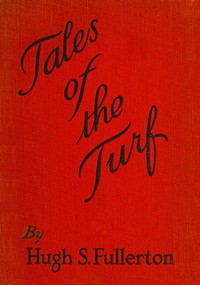
The catalog record for Tales of the turf — Text and Context provides practical reading context through 17,479 words, 1 hr 16 min estimated reading time, and 8 detected text sections.
The text analysis averages about 16.3 words per sentence, while the detected sections provide another way to judge how the source is divided.
Project Gutenberg metadata also associates the work with “Short stories, American,” connecting these edition facts with the source record’s subject description.
Explore this collection
These alternatives are selected using recorded categories and estimated reading time.
About 86 minutes
Fantasy Juvenile Worlds
19,582 recorded words. 10 minutes difference from this book's estimate.
View Gutenberg source #902About 35 minutes
Fantasy Juvenile Worlds
7,987 recorded words. 41 minutes difference from this book's estimate.
View Gutenberg source #71065About 34 minutes
Fantasy Juvenile Worlds
7,749 recorded words. 42 minutes difference from this book's estimate.
View Gutenberg source #74142Search stored excerpts and compare books → Choose by your preferences →
Choices use stored catalog measurements. Estimates vary with reading speed. A shared category is a catalog label, not a claim that two books have the same argument or literary quality.
Search reads excerpt text stored with this catalog and links to its associated Gutenberg record. The connection is stored in the site database; this tool does not recheck that every excerpt is word-for-word identical to that external record. Excerpt search does not cover every chapter and does not verify historical publication dates.
Catalog snapshot checked: 2026-09-25. Coverage: 93 public books, 93 available source excerpts.
Calculated from edition completeness, EPUB availability, text structure and catalogue metadata. Not a user rating.
Total of 100 points, scaled to a 2.5-5.0 range. Editions with an empty description or a missing EPUB file are not scored.
Public-domain source text
The source text is kept in the dedicated reader, separate from this catalogue record and its commentary.
Hugh S. Fullerton's Tales of the Turf opens with a foreword that calls the author 'America’s foremost sports-writer' and a preface insisting that 'all men love a horse who know a horse.' The eight stories that follow are built around racetrack life, but the catalog subjects—'Short stories, American' and 'Horse racing—Fiction'—only partly capture what the excerpts reveal. The tales are less about racing as sport than about the people who orbit the track: touts, rubbers, old trainers, and down-on-their-luck bettors. Fullerton's voice is colloquial, salted with racing slang, and his characters often speak in dialect. The preface warns that the stories are 'based upon real incidents and real characters,' and the dedication to the horse Morvich—'offspring of a sprinter' who proved 'handicaps of birth and breeding are not insurmountable'—signals a moral interest in heart over pedigree.
The excerpts show a writer attentive to the speech and social texture of the racetrack world. In 'Hardshell' Gaines, the title character is introduced through his nickname, derived from a religious distinction between 'Hardshell Baptists' and 'Washfoots.' The story 'Toutin’ Mistah Fox' opens with a detailed description of Prosias Trimble, a Black tout reduced to working in a Turkish bath after the New Orleans meeting ends. Fullerton renders Trimble's dejection through his 'protuberant lower lip' and 'russet shoes, rapier-pointed,' and the narrative voice shifts to match the character's perspective. The track is called 'the only pure democracy of the world' in the preface, and the stories bear this out: characters range from a dying tout nicknamed 'Jaundice' to a little rector who learns to talk about 'handicaps and weights.' The language is specific to the milieu—'pulling chasers,' 'carryin’ too much weight,' 'writing your own ticket'—and Fullerton uses it to build a world where moral questions are framed in betting terms.
The preface states that 'the gameness, the courage, the fighting spirit of the thoroughbred' arouses 'the finest instincts' in man, and the dedication to Morvich praises the horse's 'heart' over 'straight stifles' and 'weight cloths.' This idea recurs in the story of Jaundice, a tout who confesses to pulling horses and cheating. In the hospital, he tells the narrator that a little rector assured him 'the Judges don’t set a guy down forever if he is sorry.' Jaundice's final speech—'I always was sorry when I pulled one of them bum chasers when he was trying. It wasn’t square to the horse'—makes the horse the moral center. The rector's funeral sermon uses racing language: 'handicaps and weights, and keeping on trying all the time.' Fullerton does not present a systematic theology; instead, he lets the track's own vocabulary carry the weight of redemption. The dying man's last bet is on mercy, and the story ends with the rector offering odds that Jaundice 'cashes that last bet.'
Fullerton grounds his stories in precise, often overlooked settings. 'Toutin’ Mistah Fox' takes place in the St. Charles Hotel Turkish baths in New Orleans, where 'sixty fat men snoring in sixty keys' fill the rooms. The story explains that the winter meeting at the Fair Grounds has ended, and the 'army of men and horses' has moved north, leaving Prosias Trimble behind. His fall from strutting in 'pearl-colored spats' and a 'four-carat near-diamond' to working as a rubber is measured in the loss of his 'vanities vain.' The economic rhythms of the racing circuit dictate the characters' lives: when the horses leave, the touts become bathhouse workers. In 'Hardshell' Gaines, the old trainer's farm in Tennessee and his baggy garments 'which carried the odor of horses' place him in a specific, hardscrabble world. The stories do not romanticize the track; they show it as a place of constant movement, where a man's worth is measured by his knowledge of horses and his ability to keep trying under weight.
Readers coming to Tales of the Turf from the catalog subjects should expect less action on the track and more talk in the paddock, the bathhouse, and the hospital bed. Fullerton is less interested in race results than in the code of gameness that binds his characters to horses and to each other. The stories reward attention to dialect, to the economic pressures of the racing circuit, and to the way moral arguments are made in the language of odds and handicaps. The preface's claim that the track is 'the only pure democracy' is tested in every tale.
Reading Fullerton’s racetrack stories, I kept thinking about that old anthology, Atlantic Narratives: Modern Short Stories; Second Series — Context and Discussion. Both carry that same patient hush—waiting by the rail, studying a horse’s eye, knowing luck turns quietly. They feel like voices from another century, unhurried, in no hurry to prove anything. Just people trying their best, honestly told.
A brief reflection can help important ideas stay with you longer.