About 34 minutes
Raw men — Reading Notes
Fantasy Juvenile Worlds
7,749 recorded words. 1 minutes difference from this book's estimate.
View Gutenberg source #74142
For The hyena — Inside the Classic, the stored edition analysis reports 7,987 words, 35 min estimated reading time, and 1 detected text section.
The text analysis averages about 17.3 words per sentence, while the detected sections provide another way to judge how the source is divided.
Project Gutenberg metadata also associates the work with “Short stories,” connecting these edition facts with the source record’s subject description.
Explore this collection
These alternatives are selected using recorded categories and estimated reading time.
About 34 minutes
Fantasy Juvenile Worlds
7,749 recorded words. 1 minutes difference from this book's estimate.
View Gutenberg source #74142About 34 minutes
Fantasy Juvenile Worlds
7,620 recorded words. 1 minutes difference from this book's estimate.
View Gutenberg source #74698About 27 minutes
Fantasy Juvenile Worlds
6,194 recorded words. 8 minutes difference from this book's estimate.
View Gutenberg source #66494Search stored excerpts and compare books → Choose by your preferences →
Choices use stored catalog measurements. Estimates vary with reading speed. A shared category is a catalog label, not a claim that two books have the same argument or literary quality.
Search reads excerpt text stored with this catalog and links to its associated Gutenberg record. The connection is stored in the site database; this tool does not recheck that every excerpt is word-for-word identical to that external record. Excerpt search does not cover every chapter and does not verify historical publication dates.
Catalog snapshot checked: 2026-09-25. Coverage: 93 public books, 93 available source excerpts.
Calculated from edition completeness, EPUB availability, text structure and catalogue metadata. Not a user rating.
Total of 100 points, scaled to a 2.5-5.0 range. Editions with an empty description or a missing EPUB file are not scored.
Public-domain source text
The source text is kept in the dedicated reader, separate from this catalogue record and its commentary.
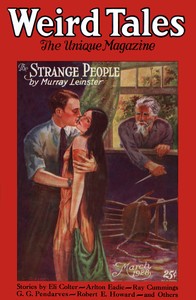
From its opening sentence, Robert E. Howard's 'The Hyena' (first published in Weird Tales, March 1928) establishes a narrator whose distrust of the fetish-man Senecoza hardens into hatred. The story moves through a series of sharply defined scenes: the trading-post ranch, the open veldt, a riderless horse, a hut among trees, and a prolonged bush duel. These shifts are not merely geographical; they mark escalating stages of a conflict that is as much psychological as physical. The recurring sound of a hyena's laugh punctuates key moments, linking the animal's eerie call to the menace of Senecoza. This note examines how Howard structures the narrative around the narrator's growing obsession and the landscape's role in the chase.
The narrator's initial distrust of Senecoza is described in visceral terms: 'from vague distrust the idea eventually grew into hatred.' Howard grounds this antipathy in the narrator's own background—'Because I came from Virginia, race instinct and prejudice were strong in me'—and in a feeling of inferiority that Senecoza 'constantly inspired.' The fetish-man is portrayed as a 'lean, black giant' with features that 'more resembled Berber than Bantu,' a description that sets him apart from the local tribes. The narrator's perspective is openly biased; he admits to being 'young and impetuous' and possessing 'a large amount of curiosity.' This self-awareness does not make him reliable, but it does make his fear palpable. The reader is left to weigh his judgments against the actions of other white characters, like Ludtvik Strolvaus, who dismisses the threat. The tension between the narrator's subjective view and the apparent calm of the ranch creates an early unease.
The hyena's laugh appears at critical junctures, functioning almost as a narrative punctuation mark. Early in the story, the sound is merely atmospheric, but during the climactic bush duel, it becomes a direct accompaniment: 'Away off over the veldt a hyena sounded his fiendish laugh and another answered, closer at hand.' The narrator's reaction—'The cold sweat broke out on my brow'—ties the animal's call to his fear of Senecoza. Howard does not explain the connection; instead, the laugh recurs as an auditory signal that the fetish-man is near or that danger is imminent. This technique mirrors the structure of a chase, where sound precedes sight. The hyena is never fully personified, but its laugh becomes a leitmotif for the predatory, mocking quality of Senecoza himself. The story's title thus points not to a literal hyena but to a pattern of menace that echoes across the veldt.
The narrative alternates between confined settings—the stockade, the hut, the bush covert—and the vast, open veldt. The ranch is described as 'a kind of slope, overlooking countless miles on miles of the finest grazing land,' a position of apparent safety that is repeatedly breached. The chase sequence is a series of dashes across open ground: the narrator rides 'like drifting smoke' through raiders, then pushes an exhausted mare 'mercilessly' toward the hut. The final duel takes place in 'the scanty veldt-bushes' and 'tall grass,' where movement is reduced to 'crawling, slipping.' Howard uses the contrast between the open veldt, where horses can gallop, and the close bush, where men crouch and trade shots, to control pacing. The story's rhythm accelerates during horseback pursuits and slows to a tense crawl in the hide-and-seek game, creating a physical analogue to the narrator's mounting desperation.
The excerpt breaks off during the final confrontation, leaving the outcome uncertain. The narrator has disarmed Senecoza, but the fetish-man 'sprang away into the grass and vanished,' only to reappear with a rifle. The last action shows the narrator pushing his 'one remaining cartridge' into a six-bore breech-loader, waiting for a careless movement. The arrival of Ellen with 'at least twenty men' suggests rescue is near, but the story does not resolve the duel. This structural choice—ending on a moment of suspended violence—is typical of Howard's adventure fiction, where the focus is on the struggle rather than its conclusion. The reader is left with the image of the narrator crouched in covert, the hyena's laugh echoing, and the question of whether Senecoza will be hunted or hunter. The incomplete excerpt underscores that the story's power lies in the chase itself, not in a tidy resolution.
Readers approaching 'The Hyena' should attend to how Howard builds suspense through the narrator's limited, prejudiced perspective and the rhythmic alternation of open and enclosed spaces. The hyena's laugh is not merely local color but a structural device that signals threat. The story rewards attention to the way movement—across the veldt, into the bush, between horse and foot—shapes the narrative tempo. The incomplete duel at the end is not a flaw but a deliberate choice that leaves the reader in the same state of uncertainty as the narrator.
I kept thinking about that hyena’s laugh long after closing the story—how distrust creeps in through the smallest cracks. It reminded me of something quieter I found in Raw men — Reading Notes, where the unease doesn’t shout, just settles beside you. Some books stay that way, like a dim lamp left on in another room.
A brief reflection can help important ideas stay with you longer.