About 582 minutes
Short Stories for English Courses — Reading Notes
Adventure Picaresque Fiction
133,786 recorded words. 12 minutes difference from this book's estimate.
View Gutenberg source #5403
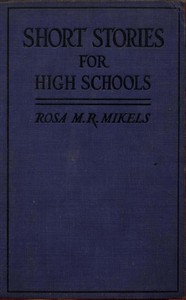
Before opening Short Stories for High Schools — Reading Notes, the edition data offers a quick orientation: 136,457 words, 9 hr 54 min estimated reading time, and 28 detected text sections.
The text analysis averages about 19.0 words per sentence, while the detected sections provide another way to judge how the source is divided.
Project Gutenberg metadata also associates the work with “Short stories, American,” connecting these edition facts with the source record’s subject description.
Explore this collection
These alternatives are selected using recorded categories and estimated reading time.
About 582 minutes
Adventure Picaresque Fiction
133,786 recorded words. 12 minutes difference from this book's estimate.
View Gutenberg source #5403About 668 minutes
Adventure Picaresque Fiction
153,517 recorded words. 74 minutes difference from this book's estimate.
View Gutenberg source #72326About 504 minutes
Adventure Picaresque Fiction
115,869 recorded words. 90 minutes difference from this book's estimate.
View Gutenberg source #38172Search stored excerpts and compare books → Choose by your preferences →
Choices use stored catalog measurements. Estimates vary with reading speed. A shared category is a catalog label, not a claim that two books have the same argument or literary quality.
Search reads excerpt text stored with this catalog and links to its associated Gutenberg record. The connection is stored in the site database; this tool does not recheck that every excerpt is word-for-word identical to that external record. Excerpt search does not cover every chapter and does not verify historical publication dates.
Catalog snapshot checked: 2026-09-25. Coverage: 93 public books, 93 available source excerpts.
Calculated from edition completeness, EPUB availability, text structure and catalogue metadata. Not a user rating.
Total of 100 points, scaled to a 2.5-5.0 range. Editions with an empty description or a missing EPUB file are not scored.
Public-domain source text
The source text is kept in the dedicated reader, separate from this catalogue record and its commentary.
The editor’s preface frames the collection as a response to a perceived gap: students confined to “older literary classics” need something “that pulses with present life.” Mikels argues that the short story suits “our varied, hurried, efficient American life,” citing the dictagraph, telephone, and automobile as markers of modernity. This rationale shapes the selection—twenty-one stories by American and British authors, ranging from Twain’s vernacular humor to Stevenson’s psychological suspense. The excerpts show a deliberate mix of regional dialects (Harris’s “A French Tar-Baby,” Page’s “Marse Chan”), tight plotting (O. Henry’s “The Ransom of Red Chief”), and moral ambiguity (Stockton’s “The Lady or the Tiger?”). Readers should note how the preface’s emphasis on “compact and compelling” storytelling is borne out in the chosen works.
Mikels’s preface is more than a justification; it is a pedagogical manifesto. She writes that students are “appalled at the quantity of material” and “welcome any instruction that enables them to know the good from the bad.” This frames the anthology as a guided sampler, not a comprehensive survey. The preface also reveals a tension: the editor reveres classics but wants “something additional.” The stories are thus positioned as supplements, not replacements. For a first reading, the preface’s criteria—compactness, modernity, moral instruction—offer a lens. Notice how “The Gold Bug” (Poe) satisfies the demand for puzzle-like structure, while “The Revolt of Mother” (Freeman) delivers social commentary within a domestic frame. The preface’s language (“pulses with present life”) also hints at a preference for stories that feel immediate, even if they are decades old.
Several excerpts rely on heavy dialect to establish character and setting. In Twain’s “The Jumping Frog,” the narrator’s vernacular (“thish-yer Smiley,” “cal’lated to educate him”) is not decoration but the story’s engine—the humor depends on the deadpan, rambling delivery. Similarly, Harris’s “A French Tar-Baby” and Stuart’s “Sonny’s Christenin’” use dialect to root the reader in specific communities. Mikels’s preface does not discuss dialect explicitly, but the selection suggests she valued regional authenticity. For readers, these stories demand careful attention to pronunciation and rhythm; the dialect slows reading and rewards rereading. Compare this with Kipling’s “Wee Willie Winkie,” which uses a child’s perspective and military slang, or Page’s “Marse Chan,” where dialect signals nostalgia for the antebellum South. The variety in dialect usage—from comic to sentimental—shows the range of effects possible within the form.
Several stories in the excerpts employ a frame narrative or an unreliable teller. “The Jumping Frog” is told by a garrulous barroom informant to a skeptical listener; the humor arises from the gap between the teller’s earnestness and the absurdity of the tale. “The Lady or the Tiger?” ends with a question that forces the reader to judge the narrator’s own uncertainty. “Markheim” (Stevenson) uses a third-person limited perspective that gradually reveals the protagonist’s moral crisis. Mikels’s preface does not highlight this technique, but the anthology’s structure—placing these stories side by side—invites comparison. A first-time reader might track how each story manages information: who knows what, and when. In “The Gold Bug,” the solution depends on a cipher, making the reader a co-detective. In “Gallegher,” the newspaper setting creates a race against time. These narrative strategies align with Mikels’s call for “compact and compelling” fiction.
Several selections resist clear moral resolution. Stockton’s “The Lady or the Tiger?” famously leaves the outcome to the reader, a device that was controversial in 1882 and remains provocative. “The Outcasts of Poker Flat” (Harte) blends sentiment with grim fate, refusing easy redemption. “The Revolt of Mother” ends with a quiet triumph that subverts gender roles without overt commentary. Mikels’s preface emphasizes the short story’s suitability for “instruction,” but these works complicate any simple lesson. For a first reading, it is worth noting how each story handles its ending: does it close firmly, or leave threads dangling? Compare the conclusive justice of “The Ransom of Red Chief” (where the kidnappers pay to be rid of the boy) with the ambiguous sacrifice in “A Messenger” (Andrews). This variety suggests that Mikels valued stories that provoke discussion rather than deliver pat morals.
Readers approaching this anthology for the first time should treat the preface as a key to the editor’s intentions, but not as a summary of the stories’ effects. The excerpts reveal a collection that prizes variety—in voice, setting, and moral stance—over uniformity. Pay attention to how each story uses its opening lines to establish tone, and how the endings either satisfy or unsettle. The anthology’s structure, moving from van Dyke’s sentimental “The First Christmas-Tree” to Stevenson’s dark “Markheim,” charts a deliberate arc from innocence to experience. Use the table of contents as a map, but let the stories themselves guide your reading.
That rainy afternoon, I kept returning to Poe’s grim little narrators, how their calm voices made dread feel almost domestic. Later, I found myself thinking about silence as a character—what a story leaves unsaid. That’s when I stumbled upon The silent cabin — Background and Themes, and the quiet there felt like an old friend’s hand on my shoulder.
Capture what you thought, learned, and would like to remember.