About 177 minutes
Twilight Stories — Background and Themes
Adventure Picaresque Fiction
40,507 recorded words. 14 minutes difference from this book's estimate.
View Gutenberg source #594
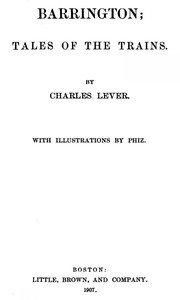
For Tales of the Trains Being Some Chapters of Railroad Romance by Tilbury Tramp, Queen's Messenger — Text and Context, the stored edition analysis reports 37,437 words, 2 hr 43 min estimated reading time, and 4 detected text sections.
The text analysis averages about 23.4 words per sentence, while the detected sections provide another way to judge how the source is divided.
Project Gutenberg metadata also associates the work with “Fiction,” connecting these edition facts with the source record’s subject description.
Explore this collection
These alternatives are selected using recorded categories and estimated reading time.
About 177 minutes
Adventure Picaresque Fiction
40,507 recorded words. 14 minutes difference from this book's estimate.
View Gutenberg source #594About 186 minutes
Adventure Picaresque Fiction
42,777 recorded words. 23 minutes difference from this book's estimate.
View Gutenberg source #63016About 191 minutes
Adventure Picaresque Fiction
43,816 recorded words. 28 minutes difference from this book's estimate.
View Gutenberg source #63015Search stored excerpts and compare books → Choose by your preferences →
Choices use stored catalog measurements. Estimates vary with reading speed. A shared category is a catalog label, not a claim that two books have the same argument or literary quality.
Search reads excerpt text stored with this catalog and links to its associated Gutenberg record. The connection is stored in the site database; this tool does not recheck that every excerpt is word-for-word identical to that external record. Excerpt search does not cover every chapter and does not verify historical publication dates.
Catalog snapshot checked: 2026-09-25. Coverage: 93 public books, 93 available source excerpts.
Calculated from edition completeness, EPUB availability, text structure and catalogue metadata. Not a user rating.
Total of 100 points, scaled to a 2.5-5.0 range. Editions with an empty description or a missing EPUB file are not scored.
Public-domain source text
The source text is kept in the dedicated reader, separate from this catalogue record and its commentary.
Charles Lever, writing under the pseudonym 'Tilbury Tramp, Queen’s Messenger,' opens Tales of the Trains with a manifesto: the railroad has so transformed society that literature must abandon pastoral and romantic conventions. The introduction explicitly compares the shock of modernity to an earthquake, arguing that 'the battle-and-murder school' and even the novels of 'Boz' cannot compete with the raw reality of a coroner’s inquest. This is not a nostalgic collection but a deliberate experiment in matching narrative form to mechanical motion.
The stories that follow—such as 'The Coupé of the North Midland' and 'The White Lace Bonnet'—are framed as conversations between Tramp and a garrulous fellow traveler, Mr. Yellowley, whose digressions on love and adventure are repeatedly cut short by the demands of the railway timetable. The result is a hybrid of travel sketch, comic monologue, and romantic intrigue, all propelled by the rhythm of the rails.
Lever adopts the persona 'Tilbury Tramp, Queen’s Messenger'—a name that signals both the speed of rail travel and the official dispatch of royal communications. This framing device allows the narrator to move between stories, collecting anecdotes from fellow passengers. In the excerpt, Tramp listens to Mr. Yellowley’s tale of a shipboard romance, but repeatedly checks his watch, insisting they 'skip' lengthy emotions because 'it only wants a quarter to twelve.' The tension between Yellowley’s expansive storytelling and Tramp’s punctuality mirrors the central conflict of the collection: old-fashioned narrative leisure versus the relentless pace of modern travel.
The introduction explicitly positions these tales as a new literary form. Lever argues that historical novels and stage plays have lost their power because readers are now more informed and mobile. The 'great reformer'—the railroad—has been ignored by writers, who still dwell on kings, cardinals, and 'the wild life of the Prairies.' By contrast, Lever’s stories are set in the confined spaces of train carriages and steamships, where chance encounters and brief conversations replace epic quests. Mr. Yellowley’s shipboard romance, for instance, revolves around 'little attentions of the table, passing the salt, calling for the pepper' as modern substitutes for 'mutilating giants and spitting dragons.'
The volume is illustrated by Hablot Knight Browne, better known as 'Phiz,' the celebrated artist who collaborated with Charles Dickens. While the excerpts do not include the illustrations themselves, their presence is noted in the metadata and title page. Phiz’s style—characterized by energetic line work, exaggerated expressions, and crowded compositions—would have complemented Lever’s blend of farce and observation. Readers familiar with Phiz’s work for Pickwick Papers or David Copperfield will recognize a similar visual vocabulary of comic types and bustling scenes, here adapted to the railway carriage and the ship’s deck.
These tales reward readers who enjoy digressive, conversational fiction and period social commentary. Lever’s experiment is not always seamless—the frame narrative can feel strained—but the best moments capture the peculiar intimacy of shared travel. Approach the book as a series of vignettes rather than a plotted novel, and note how the author’s self-consciousness about his own medium (the 'railroad romance') adds a layer of irony to even the most sentimental passages.
I found myself thinking of the way Lever’s steam trains made every stranger’s glance feel like a story’s beginning, and it reminded me of something quieter I’d once read. There’s a particular charm in the confined, accidental intimacy of shared space. It’s all there in Masterpieces of Adventure—Adventures within Walls — Themes and Context, that same sense of walls holding secrets and chance meetings.
A brief reflection can help important ideas stay with you longer.