About 217 minutes
Tales of Daring and Danger — Reading Companion
Adventure Picaresque Fiction
49,878 recorded words. 35 minutes difference from this book's estimate.
View Gutenberg source #7870
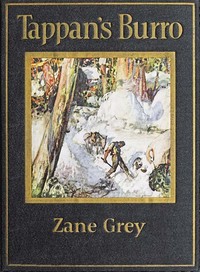
The source record for Tappan's Burro, and Other Stories — Edition Insights measures this digital text at 57,847 words, 4 hr 12 min estimated reading time, and 10 detected text sections.
The text analysis averages about 13.9 words per sentence, while the detected sections provide another way to judge how the source is divided.
Project Gutenberg metadata also associates the work with “Short stories, American,” connecting these edition facts with the source record’s subject description.
Explore this collection
These alternatives are selected using recorded categories and estimated reading time.
About 217 minutes
Adventure Picaresque Fiction
49,878 recorded words. 35 minutes difference from this book's estimate.
View Gutenberg source #7870About 210 minutes
Adventure Picaresque Fiction
48,270 recorded words. 42 minutes difference from this book's estimate.
View Gutenberg source #63014About 301 minutes
Adventure Picaresque Fiction
69,143 recorded words. 49 minutes difference from this book's estimate.
View Gutenberg source #59015Search stored excerpts and compare books → Choose by your preferences →
Choices use stored catalog measurements. Estimates vary with reading speed. A shared category is a catalog label, not a claim that two books have the same argument or literary quality.
Search reads excerpt text stored with this catalog and links to its associated Gutenberg record. The connection is stored in the site database; this tool does not recheck that every excerpt is word-for-word identical to that external record. Excerpt search does not cover every chapter and does not verify historical publication dates.
Catalog snapshot checked: 2026-09-25. Coverage: 93 public books, 93 available source excerpts.
Calculated from edition completeness, EPUB availability, text structure and catalogue metadata. Not a user rating.
Total of 100 points, scaled to a 2.5-5.0 range. Editions with an empty description or a missing EPUB file are not scored.
Public-domain source text
The source text is kept in the dedicated reader, separate from this catalogue record and its commentary.
The title story opens with Tappan gazing down at a newborn burro, feeling "pity and consternation" at its frailty. This moment establishes a central tension: the harshness of desert life versus the stubborn bonds between humans and animals. Tappan's decision to delay his journey for the weak creature sets the tone for a collection where endurance and unexpected attachments drive the narrative.
The excerpts reveal Grey's characteristic attention to physical detail—the burro's "tiny, gray lop-eared" appearance, the "crude snowshoe" in the frontispiece caption—and his tendency to frame conflict through elemental struggles: man against nature, pursuer against pursued. The later story "Yaqui" shifts to a Native American protagonist, broadening the collection's cultural scope while maintaining Grey's focus on survival and pursuit across vast landscapes.
The first story begins not with action but with a moral dilemma. Tappan, a seasoned desert prospector, is confronted by a newborn burro too weak to survive. His internal debate—"To kill it was beyond him"—reveals a character shaped by solitude yet capable of compassion. The narrative pace slows to accommodate the burro's uncertain recovery, a choice that signals Grey's interest in the rhythms of desert life rather than constant drama.
Grey's prose here is lean, relying on dialogue and interior monologue. Tappan's speech is colloquial: "Reckon neither Jennie nor I wanted it to be born." The burro's mother, Jennie, is described as "champion of all the numberless burros he had driven," a small detail that hints at a shared history. This opening establishes a pattern of observation and patience that contrasts with the more frantic pursuits in later stories.
The excerpt from "Yaqui" introduces a different kind of protagonist: a Native American runner who hunts a deer to exhaustion, breaking its neck "with his naked hands." Grey emphasizes the runner's physical prowess and spiritual connection to the land—"he lifted a long arm to the heights, as if calling upon his spirits." The prose becomes more lyrical, with phrases like "weird after-glow of sunset" and "primal attributes of man."
The story then shifts abruptly to a military attack. Mexican soldiers appear as "long line of moving dots," and Yaqui's "magnified sight" spots their guns glinting. The narrative accelerates: "Yaqui leaped with gigantic bounds down the slope." The contrast between the solitary hunt and the communal defense highlights Grey's ability to modulate tension. The soldiers' demand to "Surrender, Yaquis, save your lives!" is met with silence and gunfire, setting up a standoff that the excerpt leaves unresolved.
Across the excerpts, Grey returns to scenes of pursuit and physical endurance. In "Tappan's Burro," the chase is internal—waiting for the burro to gain strength. In "Yaqui," it is literal: a man runs a deer to death, then races to warn his people. The frontispiece caption—"Swaying backward, he fell into the upbanked wall of snow"—suggests a third story involving a snowshoe, implying varied terrains from desert to mountain.
Grey's descriptive style relies on sensory details: the "soft wind" from the east, the "glint of sunset red on shining guns," the "whistling bullets" that "spatting into the trees." He often uses similes drawn from nature—"Like an antelope he sprang over rocks." These recurring elements create a cohesive atmosphere even as the settings and characters change. Readers attentive to these patterns will find the collection unified by a theme of relentless movement against formidable odds.
The excerpts provide only fragments of each story's arc. "Tappan's Burro" ends with the burro's uncertain future; "Yaqui" breaks off during a siege. This incompleteness is a feature of the collection's structure: Grey often withholds resolution until the final pages. The table of contents lists four stories, but the excerpts cover only the first two fully, with hints of a third involving snow and a fourth possibly featuring a character named Siena or Emihiyah.
Readers should approach the collection expecting episodic tension rather than continuous plot. Grey builds suspense through physical detail and incremental action—the deer's slowing pace, the soldiers' encircling movement—rather than psychological depth. The stories reward attention to landscape and bodily effort. The lack of closure in the excerpts is not a flaw but an invitation to read on, trusting that Grey will deliver the hard-won conclusions his characters' struggles demand.
Grey's collection rewards readers who attend to the physical world he constructs: the weight of a snowshoe, the angle of sunlight on a rifle barrel, the labored breathing of a pursued deer. The excerpts offer a cross-section of his methods—from the quiet opening of "Tappan's Burro" to the violent climax of "Yaqui." A first reading might focus on how Grey varies pace and perspective across the four stories, noting how each protagonist faces a different form of trial. The burro, the runner, the man in snow—all are defined by their capacity to endure.
Zane Grey’s lonely burro and that sun-bleached desert always remind me of how quiet survival can be, and how stubborn. There’s a similar hush in the old guide called A Personal Problem — A Reader’s Guide — not loud answers, just patient, private company. I’ve shelved them near each other for years, and I think they’ve grown fond.
Answer a few questions and save a private reflection on this device.