About 594 minutes
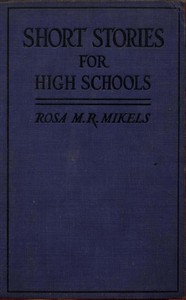
Short Stories for High Schools — Reading Notes
Adventure Picaresque Fiction
136,457 recorded words. 12 minutes difference from this book's estimate.
View Gutenberg source #50543

Before opening Short Stories for English Courses — Reading Notes, the edition data offers a quick orientation: 133,786 words, 9 hr 42 min estimated reading time, and 13 detected text sections.
The text analysis averages about 18.7 words per sentence, while the detected sections provide another way to judge how the source is divided.
Project Gutenberg metadata also associates the work with “Short stories, American,” connecting these edition facts with the source record’s subject description.
Explore this collection
These alternatives are selected using recorded categories and estimated reading time.
About 594 minutes
Adventure Picaresque Fiction
136,457 recorded words. 12 minutes difference from this book's estimate.
View Gutenberg source #50543About 504 minutes
Adventure Picaresque Fiction
115,869 recorded words. 78 minutes difference from this book's estimate.
View Gutenberg source #38172About 668 minutes
Adventure Picaresque Fiction
153,517 recorded words. 86 minutes difference from this book's estimate.
View Gutenberg source #72326Search stored excerpts and compare books → Choose by your preferences →
Choices use stored catalog measurements. Estimates vary with reading speed. A shared category is a catalog label, not a claim that two books have the same argument or literary quality.
Search reads excerpt text stored with this catalog and links to its associated Gutenberg record. The connection is stored in the site database; this tool does not recheck that every excerpt is word-for-word identical to that external record. Excerpt search does not cover every chapter and does not verify historical publication dates.
Catalog snapshot checked: 2026-09-25. Coverage: 93 public books, 93 available source excerpts.
Calculated from edition completeness, EPUB availability, text structure and catalogue metadata. Not a user rating.
Total of 100 points, scaled to a 2.5-5.0 range. Editions with an empty description or a missing EPUB file are not scored.
Public-domain source text
The source text is kept in the dedicated reader, separate from this catalogue record and its commentary.
Rosa Mary Redding Mikels' preface to Short Stories for English Courses immediately establishes a pedagogical purpose: to supplement high-school reading with contemporary short fiction that 'pulses with present life.' She argues that the short story, 'compact and compelling,' suits modern American life and helps students discriminate quality in an overwhelming literary marketplace. This framing shapes the reader's expectation: the anthology is not a canon of timeless masterpieces but a tool for engaging with living literature.
Mikels opens by questioning why children's reading should be confined to 'older literary classics.' She does not dismiss those classics but advocates for adding stories 'characteristic of to-day.' The preface explicitly links the short story's form to 'our varied, hurried, efficient American life,' invoking the business lunch, dictagraph, and automobile. This contextualization primes readers to view each story as both a literary artifact and a reflection of its era. The editor's voice is direct and persuasive, positioning the anthology as a practical response to a perceived gap in education.
The excerpt from Mark Twain's 'The Jumping Frog' showcases a dense, colloquial narration that contrasts sharply with the preface's formal tone. The unnamed storyteller describes Smiley's bull-pup, Andrew Jackson, with a mix of admiration and deadpan humor: the dog would 'grab that other dog jest by the j'int of his hind leg and freeze to it.' The passage relies on hyperbole and precise dialect—'thish-yer Smiley,' 'cal'lated to educate him'—to build character. The frog Dan'l Webster, trained to catch flies, is presented with mock-seriousness. This excerpt exemplifies the anthology's inclusion of regional vernacular and comic tall-tale tradition.
The table of contents reveals a deliberate range: from Henry van Dyke's sentimental 'The First Christmas-Tree' to O. Henry's ironic 'The Ransom of Red Chief,' from Poe's Gothic 'The Gold Bug' to Wharton's psychological 'The Triumph of Night.' Mikels includes authors known for local color (Harris, Stuart, Page, Cable), humor (Riley, Twain), and realism (Galsworthy, Freeman). The preface states the book does not attempt to select 'the greatest stories' but to supply 'interesting reading belonging to the student's own time.' This curatorial stance invites readers to compare styles and themes across the collection.
A first-time reader encountering the preface and the Twain excerpt might note the tension between Mikels' earnest educational mission and the irreverent, playful voice of the story. The preface emphasizes discrimination and efficiency; the story luxuriates in digressive, rhythmic speech. This juxtaposition suggests the anthology values both instruction and entertainment. The reader is encouraged to consider how each story's form—its use of dialect, pacing, point of view—serves its effect. The excerpts do not reveal plot resolutions, so the reader must infer from tone and detail what kind of story is unfolding.
As you read through the collection, attend to how each story's opening establishes its voice and setting, and how the editor's choices in arrangement create implicit conversations between authors. The preface's emphasis on 'present life' invites you to consider what aspects of early twentieth-century American culture these stories capture or critique. Let the excerpts guide your expectations without foreclosing the surprises each complete story holds.
I keep thinking about how that anthology’s preface almost whispers to you—letting the stories settle before they speak—and it reminded me of something quieter in Nerve enough — Background and Themes, where the courage isn’t loud but just appears between lines, like a friend who holds your hand without saying why. It lingered that way.
Your answers remain private and are stored only in this browser.