About 132 minutes
A Memory of the Southern Seas 1904 — Key Ideas to Explore
Historical Psychological Social Fiction
30,200 recorded words. 12 minutes difference from this book's estimate.
View Gutenberg source #24807
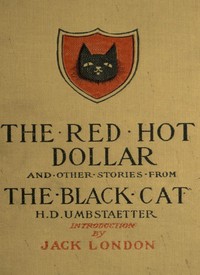
The red-hot dollar, and other stories from the Black Cat — Background and Themes can be approached with a clearer sense of reading commitment from its source measurements: 33,022 words, 2 hr 24 min estimated reading time, and 14 detected text sections.
The text analysis averages about 23.0 words per sentence, while the detected sections provide another way to judge how the source is divided.
Project Gutenberg metadata also associates the work with “Short stories, American,” connecting these edition facts with the source record’s subject description.
Explore this collection
These alternatives are selected using recorded categories and estimated reading time.
About 132 minutes
Historical Psychological Social Fiction
30,200 recorded words. 12 minutes difference from this book's estimate.
View Gutenberg source #24807About 163 minutes
Historical Psychological Social Fiction
37,428 recorded words. 19 minutes difference from this book's estimate.
View Gutenberg source #307About 179 minutes
Historical Psychological Social Fiction
41,063 recorded words. 35 minutes difference from this book's estimate.
View Gutenberg source #3818Search stored excerpts and compare books → Choose by your preferences →
Choices use stored catalog measurements. Estimates vary with reading speed. A shared category is a catalog label, not a claim that two books have the same argument or literary quality.
Search reads excerpt text stored with this catalog and links to its associated Gutenberg record. The connection is stored in the site database; this tool does not recheck that every excerpt is word-for-word identical to that external record. Excerpt search does not cover every chapter and does not verify historical publication dates.
Catalog snapshot checked: 2026-09-25. Coverage: 93 public books, 93 available source excerpts.
Calculated from edition completeness, EPUB availability, text structure and catalogue metadata. Not a user rating.
Total of 100 points, scaled to a 2.5-5.0 range. Editions with an empty description or a missing EPUB file are not scored.
Public-domain source text
The source text is kept in the dedicated reader, separate from this catalogue record and its commentary.
Jack London's introduction to The Red-Hot Dollar is as much a personal memoir as a literary endorsement. He recounts how, starving and desperate, he submitted a story to The Black Cat—only to receive a five-dollar payment that, he writes, 'saved my literary life, if he did not save my literal life.' This framing positions Umbstaetter not merely as an editor but as a catalyst for a generation of short fiction. The collection itself, drawn from the magazine's pages between 1895 and 1909, showcases a range of narrative strategies: from the tense cross-examination in 'Her Eyes, Your Honor' to the stark Western setting of 'In Hell's Cañon.' London's anecdote sets an expectation for stories that pivot on a single, decisive moment—a trait that recurs across the volume.
In 'Her Eyes, Your Honor,' the narrative voice shifts from omniscient observation to the clipped, adversarial rhythm of a trial. The defense lawyer's questioning is precise and escalating: he forces the witness to specify what exactly he remembers—'her height, her face, her complexion, her hair, her nose, and her teeth'—before the witness blurts out, 'It was her eyes, your honor!' The scene relies on pacing: the lawyer's calm, repetitive prompts build tension until the witness's outburst. The spectators, we are told, 'relaxed into a condition of restlessness that clearly showed their further disappointment,' a detail that underscores the story's interest in the gap between legal procedure and human certainty. The excerpt ends mid-argument, leaving the outcome unresolved—a deliberate withholding that mirrors the collection's broader technique of leaving key revelations to the final pages.
London's introduction does more than praise; it constructs a persona for Umbstaetter as a decisive, almost mythic figure. London describes receiving 'a short, thin letter' from a magazine 'founded by Bret Harte' that sold for twenty-five cents—details that root the collection in a specific literary marketplace. The introduction's own narrative arc—from near-suicide to rescue by a five-dollar check—mirrors the kind of sudden reversal that Umbstaetter's stories apparently favor. London's voice is colloquial and self-deprecating ('I was modest. As I tore the envelope across the end, I expected to find a check for no more than forty dollars'), which contrasts with the more formal, third-person narration of the stories themselves. This juxtaposition suggests that the collection values multiple registers of storytelling, from the personal to the procedural.
The excerpts reveal a consistent structural pattern: scenes build to a single, charged instant that is then left hanging. In the courtroom, the lawyer's cross-examination culminates in the witness's cry—'It was her eyes, your honor!'—and then the narrative cuts away: 'That is all,' the lawyer says, and the spectators are left disappointed. The story does not immediately reveal the verdict or the significance of the eyes. Similarly, London's introduction ends not with a summary of the collection but with his own story of survival, leaving the reader to connect the anecdote to the tales that follow. This technique of withholding resolution suggests that Umbstaetter's editorial eye valued suspense over closure. The reader is invited to sit with uncertainty, much as London sat waiting for a check that might never come.
Readers approaching this collection should pay attention to the moments just before a revelation—the pause before a witness answers, the silence after a lawyer sits down. Umbstaetter's stories, as framed by London, are built around such thresholds. The introduction itself functions as a kind of story, one that primes the reader to look for the hinge points in the fiction that follows. Whether in a courtroom, a mining camp, or a lonely mountain, the collection's interest lies in the instant when a character's fate turns on a single word or glance.
This collection reminds me of sitting on my grandfather’s porch, the pages of a worn magazine fluttering in his hands. That same electric anticipation of a twist. I once felt it reading A Capillary Crime, and Other Stories — Story, Setting & Ideas, where even the smallest moment holds a quiet, hidden weight. Both feel like old friends narrating secrets.
Use these questions to collect your thoughts before moving on.