About 198 minutes
The silica gel pseudomorph, and other stories — Text and Context
Fantasy Juvenile Worlds
45,373 recorded words. 1 minutes difference from this book's estimate.
View Gutenberg source #72231
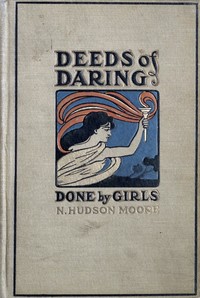
The catalog record for Deeds of Daring Done by Girls — Reading Companion provides practical reading context through 45,177 words, 3 hr 17 min estimated reading time, and 12 detected text sections.
The text analysis averages about 24.7 words per sentence, while the detected sections provide another way to judge how the source is divided.
Project Gutenberg metadata also associates the work with “Historical fiction,” connecting these edition facts with the source record’s subject description.
Explore this collection
These alternatives are selected using recorded categories and estimated reading time.
About 198 minutes
Fantasy Juvenile Worlds
45,373 recorded words. 1 minutes difference from this book's estimate.
View Gutenberg source #72231About 200 minutes
Fantasy Juvenile Worlds
45,848 recorded words. 3 minutes difference from this book's estimate.
View Gutenberg source #46366About 200 minutes
Fantasy Juvenile Worlds
45,940 recorded words. 3 minutes difference from this book's estimate.
View Gutenberg source #60904Search stored excerpts and compare books → Choose by your preferences →
Choices use stored catalog measurements. Estimates vary with reading speed. A shared category is a catalog label, not a claim that two books have the same argument or literary quality.
Search reads excerpt text stored with this catalog and links to its associated Gutenberg record. The connection is stored in the site database; this tool does not recheck that every excerpt is word-for-word identical to that external record. Excerpt search does not cover every chapter and does not verify historical publication dates.
Catalog snapshot checked: 2026-09-25. Coverage: 93 public books, 93 available source excerpts.
Calculated from edition completeness, EPUB availability, text structure and catalogue metadata. Not a user rating.
Total of 100 points, scaled to a 2.5-5.0 range. Editions with an empty description or a missing EPUB file are not scored.
Public-domain source text
The source text is kept in the dedicated reader, separate from this catalogue record and its commentary.
N. Hudson Moore's Deeds of Daring Done by Girls (1906) opens with a first-person frame: the page Jehan recounts the Duchess's exploits in the year 1392. The author immediately establishes a medieval voice through archaic phrasing—"'Tis not so," "quoth she," "bested like that by a damsel"—and a colloquial, almost breathless rhythm that mimics oral storytelling. This choice of a young male narrator for the first tale signals that the collection will often filter female daring through observers, a pattern worth tracking across the six stories.
Moore differentiates her heroines partly through the language they speak. In the opening tale, the Duchess's commands are sharp and imperious: "An you touch me I'll have you whipped, sir." The threat is delivered in a clipped, authoritative tone that contrasts with Jehan's more flustered narration. Later, in the Louisiana story, Clemence's dialogue is softer and more lyrical: "How can I sing when my heart is sad?" she asks, and her song—a French folk ballad about a lost rose and a lover named Pierre—reveals a character who expresses emotion through inherited verse rather than direct confrontation. The author uses these linguistic shifts to signal social rank, historical period, and temperament without explicit commentary.
Moore frequently juxtaposes interior elegance with exterior wildness to heighten the stakes of her heroines' actions. In the Louisiana episode, the narrator describes the Governor's mansion as reflecting "the elegance of Versailles," with gowns "brilliant flowers on a ground of gold" and lace "frail now as a spider's web." Yet immediately outside lie "untrod wildernesses" and "cypress swamps" hung with grey moss that "seemed to wave in a ghostly fashion." Clemence's journey up the Bayou Gentilly is marked by a sense of displacement: the unfamiliar birds and "long curtains of grey moss" contrast with the remembered "rose garden at the chateau at Étaples." This technique—placing refined, often French-influenced settings against raw American landscapes—recurs throughout the collection, creating a tension that mirrors the heroines' own internal conflicts.
The first story is told by Jehan, a page who is both participant and observer. His opening humiliation—being "bested" by the Duchess and mocked by other pages—establishes him as an unreliable but vivid witness. Moore uses his voice to inject humor and immediacy: "I liked to have choked with rage" is a physical, almost comic reaction that humanizes the scene. This framing device allows the author to present the Duchess's daring indirectly, through the eyes of someone who admires and fears her. It also raises questions about perspective: how much of the tale is filtered through Jehan's youthful pride? The remaining stories shift to third-person narration, but the opening frame sets a precedent for mediated heroism that readers may wish to compare across the collection.
Moore grounds her stories in specific historical moments through careful period detail. The Louisiana tale specifies the governorship of the Marquis de Vaudreuil, noting that he "brought with him the elegances and dignity which he had learned in years of life at the French court." The narrator mentions "powdered hair" and "black patches" as markers of 18th-century fashion, and describes the arrival of French and Swiss officers "bearing the stamp of continental training." These details are not merely decorative; they establish the social codes that the heroines must navigate. Similarly, the opening story's date—"the Year of Grace 1392"—and its references to "old Raoul's whip" and court protocol create a distinct medieval atmosphere. Moore's research is evident, but she subordinates it to character and action, using historical texture to make the daring deeds feel both plausible and heightened.
In the Louisiana story, Clemence's song—"Chante, rossignol, chante"—serves multiple functions. It provides a moment of emotional release, a link to her French past, and a subtle commentary on her situation: the ballad's refrain about a lost rose and a lover named Pierre mirrors her own journey with her husband. Moore includes the full French text and a translation, allowing readers to appreciate the lyricism while understanding the content. The song also shifts the scene's mood: "In five minutes the scene seemed to change," the narrator notes, as Clemence's singing transforms the gloomy swamp into something more bearable. This use of embedded song as a turning point is a distinctive authorial choice, one that appears in other tales and invites analysis of how Moore integrates music into narrative structure.
Readers attentive to Moore's craft will notice how she balances historical authenticity with a clear moral framework: courage is shown through action, but also through speech, song, and silence. The collection rewards those who compare the narrative strategies across tales—the shift from first- to third-person, the varying density of period detail, the use of dialect and song. These are not merely decorative choices; they shape how each girl's daring is perceived and remembered.
Sometimes I think of these old tales, courage built from quiet resourcefulness, and I recall another shelf where a sad, gilded bird gave away his jewels. Both speak of a generosity of spirit, a giving that costs something. It’s a gentle kinship, this understanding of what makes a heart brave. The Happy Prince, and Other Tales — Reading Companion rests near that same feeling, a softer echo. It’s a fond memory now, those pages together.
A brief reflection can help important ideas stay with you longer.