About 151 minutes
A book of martyrs — A Reader’s Guide
Science Fiction Utopias
34,562 recorded words. 5 minutes difference from this book's estimate.
View Gutenberg source #71872
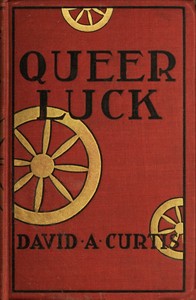
For Queer Luck: Poker Stories from the New York Sun — Themes and Context, the stored edition analysis reports 35,725 words, 2 hr 36 min estimated reading time, and 16 detected text sections.
The text analysis averages about 21.6 words per sentence, while the detected sections provide another way to judge how the source is divided.
Project Gutenberg metadata also associates the work with “Short stories, American,” connecting these edition facts with the source record’s subject description.
Explore this collection
These alternatives are selected using recorded categories and estimated reading time.
About 151 minutes
Science Fiction Utopias
34,562 recorded words. 5 minutes difference from this book's estimate.
View Gutenberg source #71872About 215 minutes
Science Fiction Utopias
49,312 recorded words. 59 minutes difference from this book's estimate.
View Gutenberg source #63307About 93 minutes
Science Fiction Utopias
21,236 recorded words. 63 minutes difference from this book's estimate.
View Gutenberg source #76387Search stored excerpts and compare books → Choose by your preferences →
Choices use stored catalog measurements. Estimates vary with reading speed. A shared category is a catalog label, not a claim that two books have the same argument or literary quality.
Search reads excerpt text stored with this catalog and links to its associated Gutenberg record. The connection is stored in the site database; this tool does not recheck that every excerpt is word-for-word identical to that external record. Excerpt search does not cover every chapter and does not verify historical publication dates.
Catalog snapshot checked: 2026-09-25. Coverage: 93 public books, 93 available source excerpts.
Calculated from edition completeness, EPUB availability, text structure and catalogue metadata. Not a user rating.
Total of 100 points, scaled to a 2.5-5.0 range. Editions with an empty description or a missing EPUB file are not scored.
Public-domain source text
The source text is kept in the dedicated reader, separate from this catalogue record and its commentary.
David A. Curtis's Queer Luck collects thirteen poker stories originally published in the New York Sun, each built around a high-stakes card game that exposes the players' nerve, ethics, and social standing. The title's "queer luck" is no mere run of good fortune—it is the strange, often ironic turn of events that can push a man toward dishonor or redemption. Curtis writes with a journalist's eye for detail, noting the "discarded pasteboards" carpeting the floor, the pocketbooks laid beside chips, and the tense silence that falls when the limit is ignored. The stories share a recurring structure: a game is described, a crisis emerges, and the outcome hinges on a single hand or decision. Yet the excerpts suggest that the real stakes are not always monetary—they involve reputation, marriage, even life itself.
In the opening story, "Why He Quit the Game," five experienced players find themselves in a "phenomenal" game where the usual limit is forgotten. Curtis emphasizes the unspoken code that governs their behavior: no one remarks on the extraordinary run of cards, "as if each man feared to break the run by mentioning it." When the Colonel finally speaks, his words are met with a "curious tone, half of question" from the Doctor. This moment of verbal rupture signals a shift from friendly contest to "struggle for blood." The narrator notes that "a bluff had not been tried for an hour," suggesting that the players have become cautious, almost superstitious, in the face of such luck. Curtis uses the physical setting—the strewn decks, the growing stacks of chips—to mirror the psychological pressure building at the table.
Another excerpt introduces a woman known as "Flash Kate," a "social outlaw" traveling on a riverboat. Her presence disrupts the polite fiction of the saloon, where ladies avoid her and men are curious. Curtis describes her with a reporter's precision: "clothes of a fashion too pronounced for respectability," "jewelry too ostentatious for daylight wear," and a "defiant swing—almost a swagger—in her carriage." Yet she behaves correctly, pretending ignorance of the snubs. The poker game that follows becomes a stage for social performance as well as gambling. Two professionals are identified, along with a cotton-factor and a veteran soldier. The narrator observes that the professionals deliberately lose small amounts on the first night, "laying the foundation for the second night's play." This calculated manipulation contrasts with the raw tension of the earlier story, showing how Curtis varies the moral stakes across the collection.
Across the excerpts, Curtis repeatedly contrasts reckless play with calculated restraint. In the first story, the players abandon their usual limit and let the "gambling fever" take hold. In the riverboat tale, the professionals exercise patience, losing a little to win more later. The narrator notes that "no two unusual hands happened to be held in the same deal," preventing a desperate struggle. This structural choice—building suspense without a climactic showdown—suggests that Curtis is more interested in the psychology of waiting than in the thrill of a big pot. The stories also share a pattern of observation: each features a narrator or witness who comments on the players' behavior, from the "military bearing" of the Major to the "nondescript" appearance of the cattle-dealer. These details ground the games in a specific social world, where a man's profession and reputation are as much at risk as his money.
Readers approaching Queer Luck will find that the poker table serves as a lens for examining character under pressure. Curtis does not explain the rules of the game; he assumes familiarity with terms like "full," "flush," and "table stakes." The stories reward attention to small gestures—the way a player speaks, the pause before a bet, the choice to fold or raise. Each tale is self-contained, but together they build a portrait of a world where luck is never just luck, and every hand carries consequences beyond the chips on the table.
Those poker tables in the old Sun stories always felt like quiet gatherings of lonely souls, each bluff a small confession. It reminded me of the solitary girls in Lucy Maud Montgomery Short Stories, 1907 to 1908 — A Closer Reading, hiding their hearts behind prim words. Both worlds have that hush before someone reveals their true hand.
Your answers remain private and are stored only in this browser.