About 516 minutes
Little Guzzy, and other stories — Themes and Context
Science Fiction Utopias
118,621 recorded words. 10 minutes difference from this book's estimate.
View Gutenberg source #67985
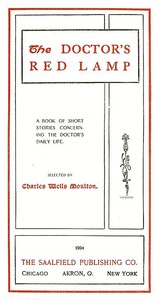
The source record for The Doctor's Red Lamp A Book of Short Stories Concerning the Doctor's Daily Life — Inside the Classic measures this digital text at 116,296 words, 8 hr 26 min estimated reading time, and 14 detected text sections.
The text analysis averages about 17.9 words per sentence, while the detected sections provide another way to judge how the source is divided.
Project Gutenberg metadata also associates the work with “Short stories,” connecting these edition facts with the source record’s subject description.
Explore this collection
These alternatives are selected using recorded categories and estimated reading time.
About 516 minutes
Science Fiction Utopias
118,621 recorded words. 10 minutes difference from this book's estimate.
View Gutenberg source #67985About 561 minutes
Science Fiction Utopias
128,886 recorded words. 55 minutes difference from this book's estimate.
View Gutenberg source #32845About 577 minutes
Science Fiction Utopias
132,598 recorded words. 71 minutes difference from this book's estimate.
View Gutenberg source #38531Search stored excerpts and compare books → Choose by your preferences →
Choices use stored catalog measurements. Estimates vary with reading speed. A shared category is a catalog label, not a claim that two books have the same argument or literary quality.
Search reads excerpt text stored with this catalog and links to its associated Gutenberg record. The connection is stored in the site database; this tool does not recheck that every excerpt is word-for-word identical to that external record. Excerpt search does not cover every chapter and does not verify historical publication dates.
Catalog snapshot checked: 2026-09-25. Coverage: 93 public books, 93 available source excerpts.
Calculated from edition completeness, EPUB availability, text structure and catalogue metadata. Not a user rating.
Total of 100 points, scaled to a 2.5-5.0 range. Editions with an empty description or a missing EPUB file are not scored.
Public-domain source text
The source text is kept in the dedicated reader, separate from this catalogue record and its commentary.
The twenty-two stories in The Doctor's Red Lamp share a unifying symbol: the red lamp that signals a physician's presence and availability. Yet the collection resists a single tone or formula. The editor, Charles Wells Moulton, assembled works by authors as different as Conan Doyle, Ambrose Bierce, and Ian Maclaren, each bringing a distinct voice to the doctor's daily life. Some stories lean toward realism, others toward the supernatural or the sentimental. The result is a volume that moves between bedside vigils, surgical crises, and moments of moral reckoning, held together by the figure of the doctor as witness and agent.
Several stories in the collection hinge on a sudden, often painful revelation that transforms the physician's understanding. In the excerpt from Dr. Armstrong, the protagonist experiences a vision of torture from a former life, described in a relentless catalog of sensations: “Crushing, grinding, distorting, straining, breaking, bending, blinding, burning.” The passage builds through anaphora and accumulation, then pivots to a message: past suffering grants insight into healing. This pattern—intense physical description followed by a moral or spiritual lesson—recurs across the anthology. The doctor’s own body or psyche becomes a site of knowledge, not just the patient’s.
The collection employs multiple narrative strategies. Some stories are told in the first person by the doctor himself, others by a patient or a third-person observer. John Bartine’s Watch: The Doctor’s Story by Ambrose Bierce uses a doctor-narrator to frame a supernatural tale, while A Doctor of the Old School by Ian Maclaren adopts a nostalgic, almost hagiographic tone. The table of contents lists titles that signal setting or character type: “The Village Doctor,” “Doctor Santos: A Character Sketch,” “On the India Frontier.” This variety suggests the editor aimed for breadth rather than consistency, offering the reader a tour of different medical milieus—rural, colonial, urban, domestic.
Across the stories, the doctor occupies a liminal position: between life and death, science and faith, the ordinary and the extraordinary. In the excerpt from Dr. Armstrong, the physician destroys his manuscript of theories after a vision, abandoning speculation for practical healing. This moment enacts a tension that runs through the volume—between the doctor as scientist and as healer, as skeptic and as spiritual guide. The red lamp itself, a physical object, becomes a threshold marker: it signals that inside, someone is attending to the boundary between health and illness, presence and absence. Several stories test that boundary with supernatural or psychological twists.
Many of the stories follow the structure of a medical case: a patient presents with symptoms, the doctor intervenes, and a resolution occurs—often with an unexpected turn. This case-study format gives the collection a procedural rhythm, but the outcomes are rarely straightforward. In The Surgeon’s Miracle by Joseph Kirkland, the title itself promises an extraordinary event. Other stories, like The Curing of Kate Negley by Lucy S. Furman, focus on a single patient’s transformation. The anthology’s organization, with 22 stories of varying lengths, allows the reader to experience a series of discrete medical encounters, each with its own setting and moral weight.
Readers approaching The Doctor's Red Lamp will find a collection that rewards attention to its recurring motifs—the lamp, the vision, the case—rather than a unified plot. The stories are best read as individual portraits of a profession in transition at the turn of the twentieth century. The editor’s preface notes that the volume is “offered without critical comment,” leaving the reader to draw connections between the supernatural tale and the domestic sketch, the colonial adventure and the character study.
Reading these doctor stories, I thought of my father’s worn leather bag, the way its latch clicked open like a small promise. That same quiet devotion surfaces in The Doctor’s Red Lamp’s collectivist heft. Little Guzzy, and other stories — Themes and Context once stirred an identical ache, watching ordinary kindness rendered extraordinary by its sheer, unglamorous persistence. Some books simply hold that light steady.
Use these questions to collect your thoughts before moving on.