About 561 minutes
International Short Stories: American — Inside the Classic
Science Fiction Utopias
128,886 recorded words. 16 minutes difference from this book's estimate.
View Gutenberg source #32845
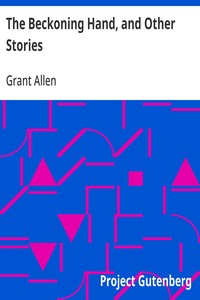
This digital edition of The Beckoning Hand, and Other Stories — Themes and Context is described by source-level measurements including 132,598 words, 9 hr 37 min estimated reading time, and 15 detected text sections.
The text analysis averages about 15.5 words per sentence, while the detected sections provide another way to judge how the source is divided.
Project Gutenberg metadata also associates the work with “Short stories,” connecting these edition facts with the source record’s subject description.
Explore this collection
These alternatives are selected using recorded categories and estimated reading time.
About 561 minutes
Science Fiction Utopias
128,886 recorded words. 16 minutes difference from this book's estimate.
View Gutenberg source #32845About 516 minutes
Science Fiction Utopias
118,621 recorded words. 61 minutes difference from this book's estimate.
View Gutenberg source #67985About 506 minutes
Science Fiction Utopias
116,296 recorded words. 71 minutes difference from this book's estimate.
View Gutenberg source #47789Search stored excerpts and compare books → Choose by your preferences →
Choices use stored catalog measurements. Estimates vary with reading speed. A shared category is a catalog label, not a claim that two books have the same argument or literary quality.
Search reads excerpt text stored with this catalog and links to its associated Gutenberg record. The connection is stored in the site database; this tool does not recheck that every excerpt is word-for-word identical to that external record. Excerpt search does not cover every chapter and does not verify historical publication dates.
Catalog snapshot checked: 2026-09-25. Coverage: 93 public books, 93 available source excerpts.
Calculated from edition completeness, EPUB availability, text structure and catalogue metadata. Not a user rating.
Total of 100 points, scaled to a 2.5-5.0 range. Editions with an empty description or a missing EPUB file are not scored.
Public-domain source text
The source text is kept in the dedicated reader, separate from this catalogue record and its commentary.
Grant Allen's The Beckoning Hand, and Other Stories opens with a scene that immediately establishes his authorial method: precise, almost clinical observation of human desperation. In the excerpt, Cecil Mitford negotiates with a gravedigger to open a coffin, and Allen renders the exchange through carefully chosen diction—the gravedigger's dialect ('I don't like de job, sah') contrasts with Cecil's clipped, urgent speech. The setting, a Jamaican graveyard under a 'water-worn and weathered stone,' is evoked with sensory detail (cactus spines, moss, lichen) that grounds the supernatural premise in tangible reality.
Allen's word choices do more than describe; they reveal psychology and escalate stakes. When Cecil kneels 'regardless of the sharp cactus spines that stung and tore his flesh,' the physical pain is secondary to his obsessive focus. The repetition of 'right, right, right, indubitably' mimics a mind racing to confirm a discovery. The gravedigger's speech—'Perhaps Massa John Cann's ghost, him come and trouble me'—uses vernacular to signal both his fear and his shrewdness. Allen avoids generic horror language; instead, he builds unease through concrete nouns: 'coffin,' 'tombstone,' 'sovereigns,' 'small-pox epidemic.' The result is a texture of realism that makes the macabre premise feel disturbingly plausible.
The bargaining scene is a masterclass in dialogue-driven tension. Cecil 'didn't beat about the bush'—his directness contrasts with the gravedigger's evasions: 'I don't tink I can do it.' Each line advances the transaction while exposing character: Cecil's 'fiendish eagerness' for a white man to die, the gravedigger's pragmatic solution to wait for a 'buckra gentleman' to be buried. Allen uses the gravedigger's conditional offer—'if you like to wait till some buckra gentleman die'—to create a grim countdown. The dialogue never moralizes; it simply presents two men negotiating over a corpse, leaving readers to judge. This restraint is typical of Allen's approach: he lets speech carry the ethical weight.
Allen structures the narrative around an agonizing delay. After the graveyard scene, the story shifts to Cecil 'settled down quietly' at Leigh Caymanas, waiting for a death. The prose mirrors his impatience: 'What an endless aimless time it seemed to wait before anybody could be comfortably buried!' The irony is sharp—'comfortably buried' in a context of grave-robbing. Allen lists the passage of time ('A month, six weeks, two months') and the frustrating health of the white population ('abominably, atrociously, outrageously healthy'). This structural choice amplifies the horror: the reader, like Cecil, is forced to wait, complicit in his macabre hope. The pacing turns the ordinary (waiting for news) into a source of dread.
Allen embeds his story in a specific colonial setting that shapes every action. The graveyard is divided by race—'John Cann grabe among de white man side'—and the small-pox epidemic kills only 'the poorest negroes.' Cecil's frustration that 'no white man caught the small-pox' reveals the racial hierarchy that governs even disease and death. The gravedigger's fear of 'duppy' (ghost) and the magistrate shows a society where supernatural belief and colonial law coexist. Allen does not explain these details; he lets them emerge through dialogue and observation. The setting is not backdrop but engine: the waiting, the bargaining, the moral compromise all depend on the specific social and physical geography of Spanish Town.
Readers approaching The Beckoning Hand should attend to how Allen builds unease through small, precise choices—a character's word, a pause in dialogue, a detail of weather or landscape. His stories reward close attention to voice and structure rather than reliance on overt shocks. The excerpt suggests a collection where the uncanny emerges from the ordinary, and where moral questions are raised through action, not commentary.
Reading this scene of whispered bargains over a grave, I remembered the hush in my grandfather’s study, where the air smelled of old leather. The Doctor's Red Lamp A Book of Short Stories Concerning the Doctor's Daily Life — Inside the Classic once gave me that same quiet unease, the sense of secrets kept close between strangers. The careful dread feels familiar, like returning to a hallway only half-remembered.
Create a short personal record of your experience with this book.