About 31 minutes
A notched gun — Context and Discussion
Science Fiction Utopias
6,916 recorded words. 1 minutes difference from this book's estimate.
View Gutenberg source #74023
For In our time — Background and Themes, the stored edition analysis reports 6,881 words, 30 min estimated reading time, and 1 detected text section.
The text analysis averages about 17.0 words per sentence, while the detected sections provide another way to judge how the source is divided.
Project Gutenberg metadata also associates the work with “Short stories, American,” connecting these edition facts with the source record’s subject description.
Explore this collection
These alternatives are selected using recorded categories and estimated reading time.
About 31 minutes
Science Fiction Utopias
6,916 recorded words. 1 minutes difference from this book's estimate.
View Gutenberg source #74023About 29 minutes
Science Fiction Utopias
6,597 recorded words. 1 minutes difference from this book's estimate.
View Gutenberg source #74150About 32 minutes
Science Fiction Utopias
7,207 recorded words. 2 minutes difference from this book's estimate.
View Gutenberg source #59494Search stored excerpts and compare books → Choose by your preferences →
Choices use stored catalog measurements. Estimates vary with reading speed. A shared category is a catalog label, not a claim that two books have the same argument or literary quality.
Search reads excerpt text stored with this catalog and links to its associated Gutenberg record. The connection is stored in the site database; this tool does not recheck that every excerpt is word-for-word identical to that external record. Excerpt search does not cover every chapter and does not verify historical publication dates.
Catalog snapshot checked: 2026-09-25. Coverage: 93 public books, 93 available source excerpts.
Calculated from edition completeness, EPUB availability, text structure and catalogue metadata. Not a user rating.
Total of 100 points, scaled to a 2.5-5.0 range. Editions with an empty description or a missing EPUB file are not scored.
Public-domain source text
The source text is kept in the dedicated reader, separate from this catalogue record and its commentary.
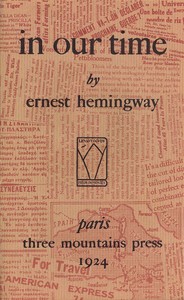
Ernest Hemingway's In Our Time (1924) was the final volume in Ezra Pound's 'Inquest' series, printed at the Three Mountains Press in a limited edition of 170 copies. The book's eighteen unnumbered chapters are not stories in the conventional sense but compressed vignettes—some barely a paragraph long—that alternate between war, bullfighting, execution, and domestic scenes. The prose is deliberately flat, almost reportorial, yet charged with physical detail: a kitchen corporal's fire worries an adjutant fifty kilometers from the front; a matador, gored through the belly, 'hung on to the horn with one hand' before fainting. Hemingway's method here is one of radical selection, omitting explanation and letting the raw sequence of images accumulate meaning.
The vignettes treat extreme violence as unremarkable. In chapter 2, a bullfight crowd hoots a wounded matador, then falls quiet only when a tired boy kills the fifth bull. The description of the goring—'the bull caught him through the belly and he hung on to the horn'—is clinical, with no moral commentary. Similarly, chapter 17's hanging of Sam Cardinella is rendered in a flat sequence of procedural details: the strapping of legs, the whispered 'Be a man, my son,' the loss of sphincter control. The guards are 'disgusted'; the drop is 'very heavy, built of oak and steel and swung on ball bearings.' Hemingway's refusal to heighten the language forces the reader to confront the mechanics of death without catharsis.
Several vignettes hinge on characters being out of place. The drunken battery in chapter 1 is 'fifty kilometers from the front,' yet the adjutant fixates on a kitchen fire. In chapter 3, a refugee column on the Karagatch road has 'no end and no beginning'—carts loaded with mattresses, mirrors, sewing machines—while a woman gives birth. The narrator is a passive observer, noting details without affect. Chapter 18 offers a jarring shift: the king works in his garden, serves whiskey, and chats about revolutionary committees as if discussing the weather. 'Like all Greeks he wanted to go to America,' the narrator remarks. This tonal disjunction—the king's jolly garden talk after a hanging—creates a world where violence and civility coexist without acknowledgment.
Hemingway's early style is already evident in the elliptical syntax. Sentences often begin with 'And' or 'Then,' creating a paratactic flow that mimics perception: 'Then it got larger and larger and larger and then smaller and smaller. Then everything commenced to run faster and faster.' In chapter 16, Maera's death is described through expanding and contracting sensations, culminating in a cinematic simile—'as when they speed up a cinematograph film.' The prose refuses to explain; it simply registers. The book's structure, with chapters that feel like fragments, reinforces this aesthetic. The final page lists the other works in Pound's series, reminding us that In Our Time was conceived as part of a larger experiment in modern prose.
Readers should approach In Our Time not as a conventional story collection but as a sequence of prose poems or sketches. The brevity of each chapter—some only a few lines—invites rereading, as the connections between war, bullfighting, and domesticity emerge through juxtaposition rather than plot. Pay attention to what is left out: the motives, the backstory, the authorial judgment. Hemingway's early work is a laboratory for the stripped-down style he would later refine, and this edition preserves the raw, unpolished quality of that experiment.
Reading In our time made me think about how some stories stay with you like a quiet ache, not needing many words to linger. That starkness, the raw edges of war and sorrow, reminded me of a certain northern collection I stumbled on recently. A Viking's love: and other tales of the North — Context and Discussion holds that same kind of cold, tender honesty, and I keep turning its pages over in my head, unhurried, like a friend’s hand on my shoulder.
Answer a few questions and save a private reflection on this device.