About 32 minutes
Night Court — Background and Themes
Science Fiction Utopias
7,207 recorded words. 0 minutes difference from this book's estimate.
View Gutenberg source #59494
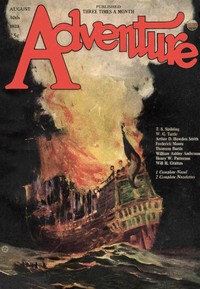
Before opening Hidden guns — Reading Notes, the edition data offers a quick orientation: 7,134 words, 32 min estimated reading time, and 1 detected text section.
The text analysis averages about 17.4 words per sentence, while the detected sections provide another way to judge how the source is divided.
Project Gutenberg metadata also associates the work with “Short stories,” connecting these edition facts with the source record’s subject description.
Explore this collection
These alternatives are selected using recorded categories and estimated reading time.
About 32 minutes
Science Fiction Utopias
7,207 recorded words. 0 minutes difference from this book's estimate.
View Gutenberg source #59494About 33 minutes
Science Fiction Utopias
7,558 recorded words. 1 minutes difference from this book's estimate.
View Gutenberg source #67288About 31 minutes
Science Fiction Utopias
6,916 recorded words. 1 minutes difference from this book's estimate.
View Gutenberg source #74023Search stored excerpts and compare books → Choose by your preferences →
Choices use stored catalog measurements. Estimates vary with reading speed. A shared category is a catalog label, not a claim that two books have the same argument or literary quality.
Search reads excerpt text stored with this catalog and links to its associated Gutenberg record. The connection is stored in the site database; this tool does not recheck that every excerpt is word-for-word identical to that external record. Excerpt search does not cover every chapter and does not verify historical publication dates.
Catalog snapshot checked: 2026-09-25. Coverage: 93 public books, 93 available source excerpts.
Calculated from edition completeness, EPUB availability, text structure and catalogue metadata. Not a user rating.
Total of 100 points, scaled to a 2.5-5.0 range. Editions with an empty description or a missing EPUB file are not scored.
Public-domain source text
The source text is kept in the dedicated reader, separate from this catalogue record and its commentary.
Henry W. Patterson's Hidden Guns opens with a slow, deliberate accumulation of snow—'fine crystals' falling with 'sullen persistency'—that traps two trappers in their cabin. The narrative voice initially matches the drifts: patient, observational, almost documentary in its catalog of daily chores. But as the weeks wear on, the prose tightens. Dialogue turns clipped and barbed, and the physical descriptions of the cabin—the blocked north window, the buried doorway—become metaphors for psychological pressure. The story's real engine is this shift from expansive, weather-bound description to the compressed, explosive action of the climax, where a hidden-draw gun trick resolves the plot in seconds.
The opening paragraphs establish a world governed by natural forces. Patterson specifies the duration—'the latter part of December and all through January'—and the effect: the cabin is buried 'clear to the peak of the squat roof.' The language is precise and sensory: 'hard-packed drifts,' 'spruce-wood shovels,' 'slanting chute.' This isn't mere scene-setting; it's a structural device. The snow dictates the trappers' routine, limits their movement, and, crucially, forces them into close quarters. The narrator's tone remains detached, almost clinical, as it records the men's 'sigh of resignation and relief' when they finally lay down their shovels. This detachment creates a baseline of normalcy against which the later tension will be measured.
Once the men are confined, Patterson shifts focus to the psychological toll. The narrative pace slows to match the 'dull routine of eating and sleeping.' Time is marked by 'the daily trip for water and more infrequent attacks on the wood-pile.' The voice becomes more interior, tracking the change from 'perfect relaxation' to 'restlessness.' The dialogue between Henderson and Hartley is a key indicator: Henderson's 'flared in sudden heat' and Hartley's suppressed wrath show how the snowbound isolation amplifies minor grievances. Patterson uses the argument as a 'safety valve'—a phrase the narrator applies to Henderson's method—but the real function is to accelerate the story's emotional tempo, preparing the reader for the intrusion of the three outlaws.
The climax arrives with a sudden, almost mechanical precision. The prose snaps into short, staccato sentences: 'A revolver appeared in each of his hands, and before one could think two spurts of flame shot out.' The earlier descriptive expansiveness is replaced by a sequence of physical actions—'leaped erect,' 'whirled to one side,' 'dived across the room'—each rendered in clear, unadorned language. The hidden-draw trick itself is the story's central puzzle, and Patterson withholds its mechanics until the final line, when Hartley explains: 'it's easier to draw from your shirt front than your pocket.' The narrative voice here is terse, almost reportorial, a stark contrast to the opening's patient accumulation of detail. This shift in pace and register is the story's defining feature.
Readers should attend to how Patterson uses the physical environment—the snow, the cabin, the fire—as both setting and narrative engine. The story's effectiveness depends on the contrast between its two halves: the slow, atmospheric buildup of cabin life and the swift, almost cinematic action of the climax. The hidden-draw trick is not just a plot device but a formal principle, mirroring the story's own structure of concealment and sudden revelation.
That cabin tension in Hidden Guns reminded me of how quiet waiting can feel so heavy. There’s a similar hush in Lucy Maud Montgomery Short Stories, 1907 to 1908 — A Closer Reading, where small domestic moments carry their own unspoken weight, lingering like an afternoon light you can’t quite forget.
Create a short personal record of your experience with this book.