About 25 minutes
The night wire — Themes and Context
Science Fiction Utopias
5,562 recorded words. 0 minutes difference from this book's estimate.
View Gutenberg source #68555
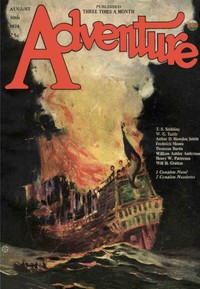
Before opening Reputation — Inside the Classic, the edition data offers a quick orientation: 5,689 words, 25 min estimated reading time, and 1 detected text section.
The text analysis averages about 16.5 words per sentence, while the detected sections provide another way to judge how the source is divided.
Project Gutenberg metadata also associates the work with “Short stories,” connecting these edition facts with the source record’s subject description.
Explore this collection
These alternatives are selected using recorded categories and estimated reading time.
About 25 minutes
Science Fiction Utopias
5,562 recorded words. 0 minutes difference from this book's estimate.
View Gutenberg source #68555About 26 minutes
Science Fiction Utopias
5,964 recorded words. 1 minutes difference from this book's estimate.
View Gutenberg source #73315About 29 minutes
Science Fiction Utopias
6,597 recorded words. 4 minutes difference from this book's estimate.
View Gutenberg source #74150Search stored excerpts and compare books → Choose by your preferences →
Choices use stored catalog measurements. Estimates vary with reading speed. A shared category is a catalog label, not a claim that two books have the same argument or literary quality.
Search reads excerpt text stored with this catalog and links to its associated Gutenberg record. The connection is stored in the site database; this tool does not recheck that every excerpt is word-for-word identical to that external record. Excerpt search does not cover every chapter and does not verify historical publication dates.
Catalog snapshot checked: 2026-09-25. Coverage: 93 public books, 93 available source excerpts.
Calculated from edition completeness, EPUB availability, text structure and catalogue metadata. Not a user rating.
Total of 100 points, scaled to a 2.5-5.0 range. Editions with an empty description or a missing EPUB file are not scored.
Public-domain source text
The source text is kept in the dedicated reader, separate from this catalogue record and its commentary.
W. C. Tuttle's 1923 short story 'Reputation' opens not with the arrival of its feared outlaw, Jeff Tigard, but with the weight of his name. The narrative is filtered through the voices of villagers in Santa Ynez, a small mission settlement near the Mexican border, who know Tigard only by reputation. The story's tension is built entirely through overheated cantina talk, where men boast and tremble in equal measure over warm beer. Tuttle uses the oppressive heat and the characters' nervous banter to create a sense of impending doom, all before the Tiger himself appears.
The story's title, 'Reputation,' is literal: the outlaw Jeff Tigard is known only through tales. The opening exclamation, 'El Tigre! Madre de Dios!', establishes him as a figure of almost supernatural terror. The villagers debate his nature: Mendez, full of warm beer, boasts that 'mortal man dies,' while Felipe trembles at the thought of Tigard cutting off his ears. The dialogue reveals that Tigard's reputation is built on hearsay—'Men have told us that he is without a conscience'—and the reader is left uncertain how much is truth and how much is legend. Tuttle never confirms the stories, leaving the outlaw's actual deeds ambiguous.
The setting is almost a character itself. Tuttle repeatedly emphasizes the oppressive heat: 'It was very warm in the little, one-story adobe cantina'; 'it was oppressive. The very sky seemed to press down upon the earth.' The heat saps energy and fuels the men's drinking and bravado. The cattle 'seemed to stand in silent wonder,' and the piñon pines appear as 'black blots against the sky-line.' This heavy atmosphere mirrors the psychological weight of Tigard's reputation, making the villagers' fear palpable even as they laugh and drink.
Tuttle uses a chorus of named speakers—Felipe, Ramon, Mendez, Pasquale—to create a communal voice. Each character reacts differently: Felipe is openly fearful, Ramon is dismissive and jocular, Mendez is boastful when drunk, and Pasquale is the pragmatic Italian. Their overlapping dialogue, with interruptions and laughter, builds a naturalistic scene. The story's structure is almost theatrical, confined to the cantina and the villagers' talk. The only action is the arrival of a mysterious rider who, in the closing lines, identifies himself as 'Jefferson Tigard' and thanks them before vanishing into the darkness.
The story's power lies in what it withholds. Tuttle never shows Tigard committing violence; the threat is entirely atmospheric. Readers should pay attention to the interplay between the villagers' words and the physical details—the warm beer, the still cattle, the dark pines. The ending, with Tigard's polite farewell, subverts expectations and leaves the reader to decide whether the reputation is earned or merely a product of collective fear.
This reminded me of how, as a boy, I’d sit with my father’s old poker anthologies, feeling the bluff and bluster of a room long before any cards hit the table. El Tigre’s shadow is all talk and quiet dread, like the imagined tells in Queer Luck: Poker Stories from the New York Sun — Themes and Context. Reputation, I suppose, is just the longest con we tell ourselves.
Capture what you thought, learned, and would like to remember.